
Discover more paintings from the 19th and 20th century on Mysterious Art Century:
Blog – Tumblr – Facebook – Instagram – Pinterest
John William Waterhouse’s Paintings Video
paintingGather Ye Rosebuds While Ye May
painting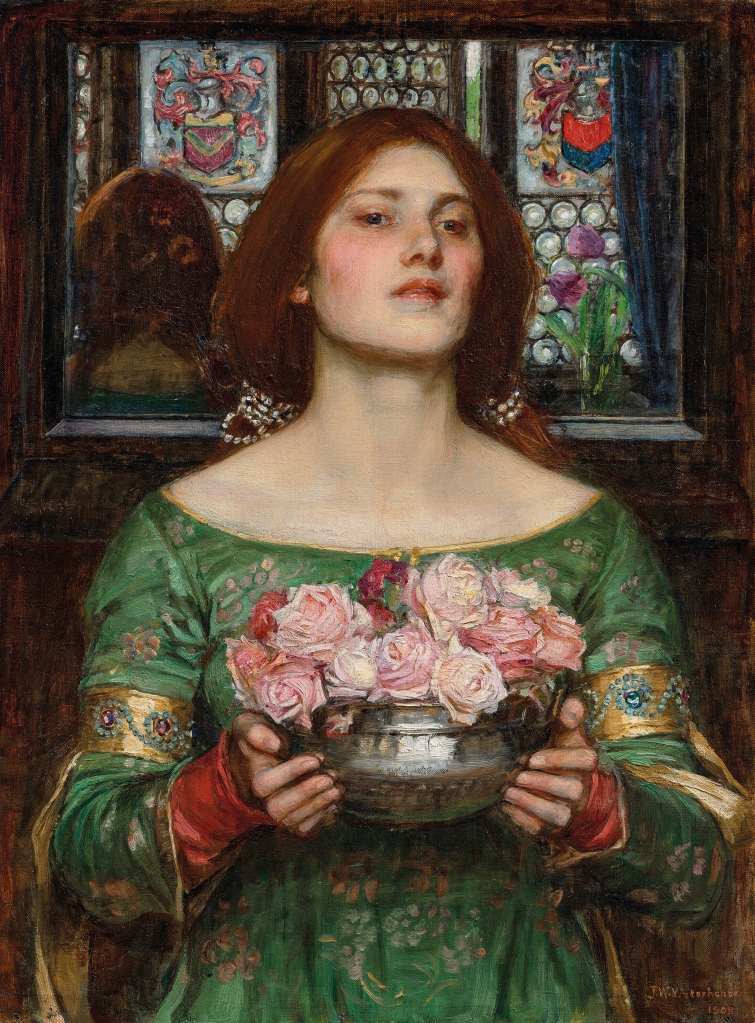
oil on canvas, 61.6 x 45.7 cm.
With this painting, Waterhouse started a six-year exploration of what we might call flower-women, a series of gorgeous, non-narrative paintings. In them, maidens carry flowers in vases, arrange them in their hair as they gaze into mirrors, or inhale their scent in gardens. Gather Ye Rosebuds while Ye May was among the earliest, taking its title from the (then) well-known poem by Robert Herrick (1591-1674), To the Virgins, to Make Much of Time:
‘Gather ye rosebuds while ye may,
Old Time is still a-flying;
And this same flower that smiles today
Tomorrow will be dying.’
The inference of beauty’s inevitable disappearance is shot throughout the series.
The present painting is a masterwork of glinting historicism, featuring an array of Waterhouse’s favourite motifs. Most notable are the red lips and rosy cheeks of the proud Rossettian model, who raises her chin just-so as she — wearing a characteristically luxurious gown — presents us with flowers freshly arranged in an iconic Waterhouse prop — an expertly painted metal bowl. The brilliant reflections are sustained in the girl’s bejewelled armbands, the pearl strands that bind her braids, and the bottle-glass windows beyond. Thus, within the same year, Waterhouse produced two completely different scenes bearing the same title — Gather Ye Rosebuds While Ye May.
Because he left behind no diaries and little correspondence, we may never know what Waterhouse really thought of the present picture, but we are sure it was purchased from the RA Summer Exhibition by the barrister Sir Frederick M. Fry. Ultimately, he came to own six paintings by Waterhouse (including the 1909 Lamia) and several of his drawings; he also owned works by other contemporary masters like Abbey, George Clausen, and Seymour Lucas. The two men were close enough that Fry attended Waterhouse’s funeral in 1917, and Gather Ye Rosebuds While Ye May remained in the Frys’ possession until his estate was dispersed at Christie’s in 1943. By then, Waterhouse and his peers were so far out of fashion that this painting was offered without its original title, called merely A lady, in green dress, holding a bowl of roses. It brought only 18 guineas, a reminder of how little such a painting mattered only 35 years after its creation, especially in the depths of a terrible war.
Study for ‘Psyche opening the Golden box’
drawing
The story of Psyche, like many Greek myths, is one of great drama and passion. Psyche, a mortal princess, is cursed by Venus who is jealous of her beauty, which has inspired many to worship her rather than pay their respects to Venus. She sends her son Cupid to shoot an arrow at her to make her fall in love with a monstrous creature. Instead, Cupid scratches himself and falls in love with Psyche. Abandoned by her family, she is saved by Zephyrus, god of the west wind, and carried away to Cupid’s palace where she is waited on by invisible servants. There, Cupid visits her every night but she is not allowed to see his face. Encouraged by her jealous sisters, she lights a lamp one night to see her lover’s face and injures Cupid in the process by dropping hot oil on him and he flees. She travels the earth searching for him and entreats Venus to help her. Venus instead sends her on a series of impossible tasks, the fourth of which is to take a golden box to the underworld to obtain a dose of beauty from Proserpine. She is told not to look in the box. Like Pandora, however, she cannot resist and opens the box, finding within it not beauty, but sleep, and she falls into a deep slumber. Cupid eventually finds her, takes her to Zeus, who allows her to become a goddess and marry Cupid on equal terms.
Waterhouse painted many mythological subjects including several depictions of Psyche: Psyche Entering Cupid’s Garden, 1904 (Harris Museum and Art Gallery) and Psyche opening the Golden Box, exhibited at the Royal Academy in 1903 (private collection). The finished picture shows Psyche, seated in a dark wood, bending her head low as she peers into the slightly open box. A small plume of smoke rises from the interior. Fewer than 150 preparatory sketches by Waterhouse are known. They consist mainly of model’s heads – generally the most important element of the painting – in chalks. Here we have a typical preparatory sketch, confidently exploring the composition with fluid strokes, exquisitely modelling the flesh of the shoulder and back of the model. Not much is known about Waterhouse’s models and while it has been argued that he had a single muse who he returned to repeatedly over the decades (Miss Muriel Foster has been identified as a contender), it may also be the case that he chose a series of women with the same swan-like neck, doe eyes, modest features, full of understated grace that made his paintings both sensual yet innocent; a duality that has delighted viewers for more than a century.
The Lady of Shalott
painting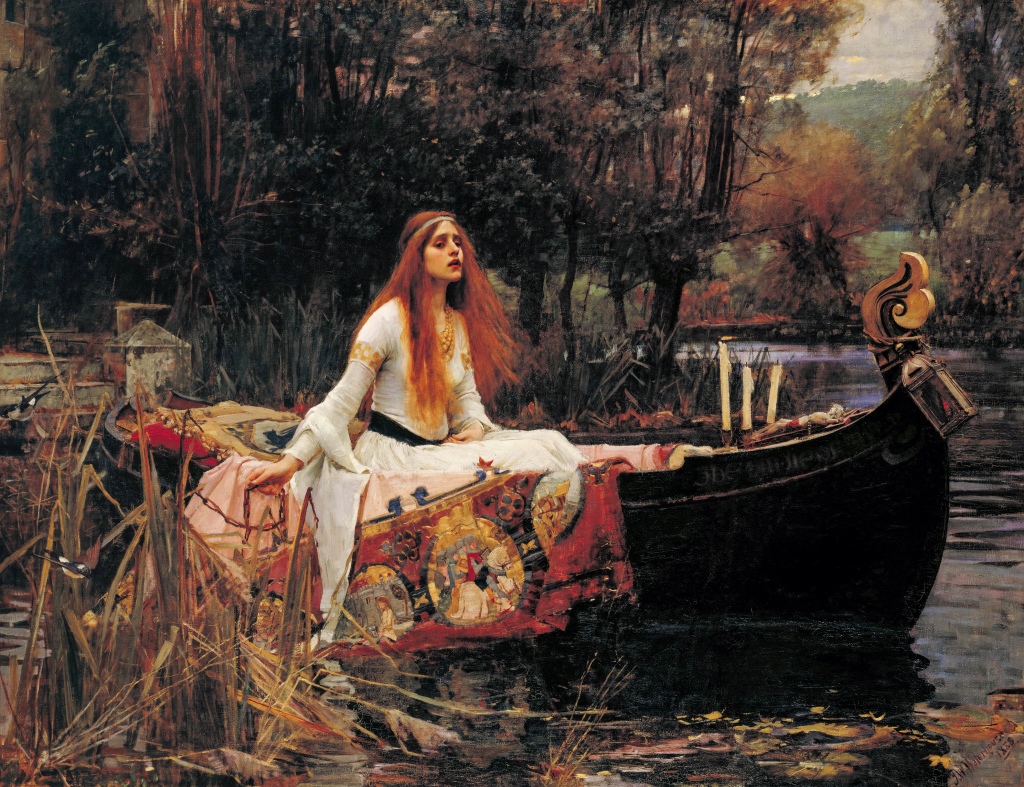
Painted in 1888, The Lady of Shalott is a representation of the ending of Alfred, Lord Tennyson’s 1832 poem of the same name. Waterhouse painted three different versions of this character, in 1888, 1894 and 1915. It is one of his most famous works, which adopted much of the style of the Pre-Raphaelite Brotherhood, though Waterhouse was painting several decades after the Brotherhood split up during his early childhood.
The picture illustrates the following lines from part IV of Tennyson’s ‘The Lady of Shalott’:
‘And down the river’s dim expanse
Like some bold seer in a trance,
Seeing all his own mischance –
With glassy countenance
Did she look to Camelot.
And at the closing of the day
She loosed the chain, and down she lay;
The broad stream bore her far away,
The Lady of Shalott.’
Tennyson’s poem, first published in 1832, tells of a woman who suffers under an undisclosed curse. She lives isolated in a tower on an island called Shalott, on a river which flows down from King Arthur’s castle at Camelot. Not daring to look upon reality, she is allowed to see the outside world only through its reflection in a mirror. One day she glimpses the reflected image of the handsome knight Lancelot, and cannot resist looking at him directly. The mirror cracks from side to side, and she feels the curse come upon her. The punishment that follows results in her drifting in her boat downstream to Camelot ‘singing her last song’, but dying before she reaches there. Waterhouse shows her letting go the boat’s chain, while staring at a crucifix placed in front of three guttering candles. Tennyson was a popular subject for artists of this period, particularly the Pre-Raphaelites. Waterhouse’s biographer Anthony Hobson relates that the artist owned a copy of Tennyson’s collected works, and covered every blank page with pencil sketches for paintings.


The landscape setting is highly naturalistic; the painting was made during Waterhouse’s brief period of plein-air painting. The setting is not identified, although the Waterhouses frequently visited Somerset and Devon. Waterhouse’s sketchbook contains numerous pencil studies for this and the painting of the same title made six years later. This second work shows the Lady at the moment she looks out of the window and the curse is fulfilled. Waterhouse also made sketches of the final scenes in which the boat bearing the Lady floats into Camelot.
Female head study for a nymph in Hylas and the Nymphs and study for the figure in Destiny
drawing

This sheet is a compelling reminder of how closely interconnected John William Waterhouse’s projects were during the mid to late 1890s. On one side is a powerfully realized head, most likely a preparatory study for one of his masterpieces, Hylas and the Nymphs (1896), and specifically for the alluring nymphs at centre who rise from the water to tempt the ancient hero. Waterhouse surely knew how crucial the girls’ expressions and poses would be to maximizing his composition’s dramatic impact, so he seems to have worked particularly hard on perfecting their heads and upper bodies via numerous drawings like this.
On the reverse we find the same face sketched more faintly (and upside down), and more strikingly a nude girl standing while drinking from (or presenting?) a shallow cup. The latter is almost certainly an early imagining of the 1900 painting Destiny, in which a maiden clad in Renaissance-era clothing (but a more modern hairstyle) raises her cup in valediction to departing galleons.
These motifs’ intermingling underscores not only the fact that Waterhouse saw such sheets as practical working tools to turn over and re-use, but also his ongoing association of women with liquids, especially water. A chronological survey of his preparatory drawings makes it difficult to tell where he stopped composing one narrative (such as Hylas and the Nymphs) and began developing the next. This drawing of a head epitomizes that continuum: the gaze and angle evoke one of Hylas’s timeless nymphs, while her upswept hairstyle appears in Destiny, which was specifically intended to benefit widows and orphans of the (painfully modern) Boer War.
Girl Holding a Bouquet
painting
An Orange Garden
painting
The painting is a heretofore-unlocated canvas from a small group of picturesque, lushly colored genre scenes that J. W. Waterhouse painted, or at least conceived, in Capri during the late 1880s. This Italian island had become increasingly popular with artists from around the world for its beautiful scenery, sunny climate, and abundant models. Having been born in Rome, ‘Nino’ Waterhouse may even have been able to converse with the locals in Italian.
An Orange Garden depicts three models picking and gathering oranges, a continuation of the traditional view that women enjoy a particularly harmonious relationship with nature, and also a portent of the maidens-stretching-to-pick-flowers theme that Waterhouse would explore for the rest of his life. This composition showcases the artist’s lively brushwork and many hallmarks of his style, such as the stone staircase that connects the scene’s upper and lower halves, the subtle pink dress and the rich mauve headscarf that move our eye along that staircase, the trees’ twisting trunks and branches, the flowers planted in terracotta pots, the weathered surfaces of the stucco architecture, and the deft juxtaposition of whites and off-whites best admired in the youngest girl’s apron.
Waterhouse’s London dealer, Agnew’s, received An Orange Garden on 1 February 1890 and sold it just 19 days later to Dr. Alfred Palmer JP, a member of the family that owned the Reading-based bakers Huntley & Palmer. Around the same time, Palmer’s Berkshire neighbor, the financier Alexander Henderson, acquired from Agnew’sthe larger Orange Gatherers and went on to become Waterhouse’s most significant patron.


Mariana in the South
painting
Waterhouse took the scene from a verse in Tennyson’s poem inspired by Shakespeare’s Measure for Measure. Mariana, abandoned by her lover, is doomed to wait in solitude in a ‘moated grange’, a metaphor for longing and unfulfilled love.
‘Low on her knees herself she cast,
Before Our Lady murmur’d she;
Complaining, “Mother, give me grace
To help my of my weary load.”
And on the liquid mirror glow’d
The clear perfection of her face.’
Waterhouse includes visual details of Tennyson’s words, including the mirror, the religious painting on the wall, and old love letters. She gazes at her reflection with a forlorn expression, her youth and beauty are being wasted. The brushwork is loose and the colours are mostly dark, but the girl is pale and glowing, her red under-dress a vibrant coral colour. There is a Pre-Raphaelite-esque Medievalism about the painting, but like Waterhouse was never strictly speaking a member of the group. Like Burne-Jones and Leighton, he was connected with the Brotherhood, but did not adhere to the doctrines that the founding members set out.
Circe Offering the Cup to Ulysses
painting
Waterhouse was inspired by Homer’s Odyssey to paint several other masterpieces, one of which is Circe Offering the Cup to Ulysses. Circe was a beautiful sorceress who turned mortals into animals by giving them a wine filled with an evil potion. Circe used such a potion on Ulysses’ crew turning them into pigs while Ulysses AKA (Odysseus) was taking care of another matter. Ulysses learned of this and was able to attain a medicine from Hermes to prevent Circe’s potions from having an effect on him. He went to Circe’, who had him drink the potion to turn him into a pig as well, when it did not work Ulysses drew his sword and threatened Circe” who, in disbelief, begged him to forgive her.


Waterhouse portrays Circe, cup in one hand, wand in the other, surrounded by purple flowers, the color of royalty, offering the potion to Ulysses. She thinks herself a queen. She sits on a golden throne, roaring lions depicted on each arm. By her side lies a pig, perhaps one of Ulysses’ men. There are other animals portrayed in the painting depicting other mortals who fell into Circe”‘s grasp, including a toad in the foreground and a duck which can be seen reflected in the left side of the mirror behind her. Also in the mirror, Ulysses himself can be seen fists clenched, ready to attack. – Kara Ross


 John William Waterhouse