Study for ‘Psyche opening the Golden box’

drawing
Study for 'Psyche opening the Golden box', black and red chalk, 22.5 x 30.5 cm.
Study for ‘Psyche opening the Golden box’, black and red chalk, 22.5 x 30.5 cm.

The story of Psyche, like many Greek myths, is one of great drama and passion. Psyche, a mortal princess, is cursed by Venus who is jealous of her beauty, which has inspired many to worship her rather than pay their respects to Venus. She sends her son Cupid to shoot an arrow at her to make her fall in love with a monstrous creature. Instead, Cupid scratches himself and falls in love with Psyche. Abandoned by her family, she is saved by Zephyrus, god of the west wind, and carried away to Cupid’s palace where she is waited on by invisible servants. There, Cupid visits her every night but she is not allowed to see his face. Encouraged by her jealous sisters, she lights a lamp one night to see her lover’s face and injures Cupid in the process by dropping hot oil on him and he flees. She travels the earth searching for him and entreats Venus to help her. Venus instead sends her on a series of impossible tasks, the fourth of which is to take a golden box to the underworld to obtain a dose of beauty from Proserpine. She is told not to look in the box. Like Pandora, however, she cannot resist and opens the box, finding within it not beauty, but sleep, and she falls into a deep slumber. Cupid eventually finds her, takes her to Zeus, who allows her to become a goddess and marry Cupid on equal terms.

Waterhouse painted many mythological subjects including several depictions of Psyche: Psyche Entering Cupid’s Garden, 1904 (Harris Museum and Art Gallery) and Psyche opening the Golden Box, exhibited at the Royal Academy in 1903 (private collection). The finished picture shows Psyche, seated in a dark wood, bending her head low as she peers into the slightly open box. A small plume of smoke rises from the interior. Fewer than 150 preparatory sketches by Waterhouse are known. They consist mainly of model’s heads – generally the most important element of the painting – in chalks. Here we have a typical preparatory sketch, confidently exploring the composition with fluid strokes, exquisitely modelling the flesh of the shoulder and back of the model. Not much is known about Waterhouse’s models and while it has been argued that he had a single muse who he returned to repeatedly over the decades (Miss Muriel Foster has been identified as a contender), it may also be the case that he chose a series of women with the same swan-like neck, doe eyes, modest features, full of understated grace that made his paintings both sensual yet innocent; a duality that has delighted viewers for more than a century.

Source

Female head study for a nymph in Hylas and the Nymphs and study for the figure in Destiny

drawing
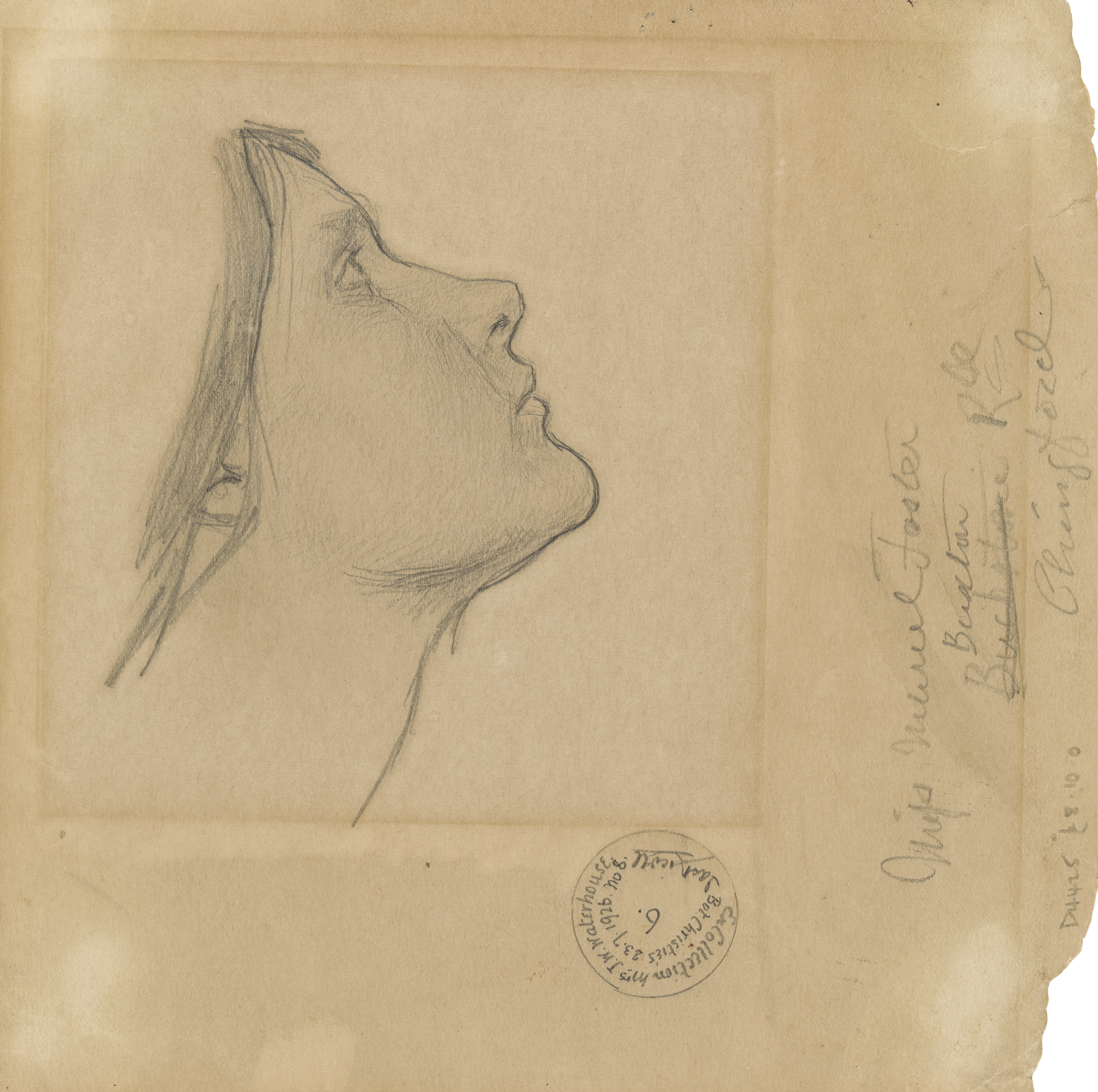
Recto: Female head study for a nymph in Hylas and the Nymphs, charcoal and pencil, 38.8 x 21.6 cm.
Verso: Study for the figure in Destiny, charcoal and pencil, 38.8 x 21.6 cm.

This sheet is a compelling reminder of how closely interconnected John William Waterhouse’s projects were during the mid to late 1890s. On one side is a powerfully realized head, most likely a preparatory study for one of his masterpieces, Hylas and the Nymphs (1896), and specifically for the alluring nymphs at centre who rise from the water to tempt the ancient hero. Waterhouse surely knew how crucial the girls’ expressions and poses would be to maximizing his composition’s dramatic impact, so he seems to have worked particularly hard on perfecting their heads and upper bodies via numerous drawings like this.

On the reverse we find the same face sketched more faintly (and upside down), and more strikingly a nude girl standing while drinking from (or presenting?) a shallow cup. The latter is almost certainly an early imagining of the 1900 painting Destiny, in which a maiden clad in Renaissance-era clothing (but a more modern hairstyle) raises her cup in valediction to departing galleons.

These motifs’ intermingling underscores not only the fact that Waterhouse saw such sheets as practical working tools to turn over and re-use, but also his ongoing association of women with liquids, especially water. A chronological survey of his preparatory drawings makes it difficult to tell where he stopped composing one narrative (such as Hylas and the Nymphs) and began developing the next. This drawing of a head epitomizes that continuum: the gaze and angle evoke one of Hylas’s timeless nymphs, while her upswept hairstyle appears in Destiny, which was specifically intended to benefit widows and orphans of the (painfully modern) Boer War.

Source

Study of a girl’s head

drawing
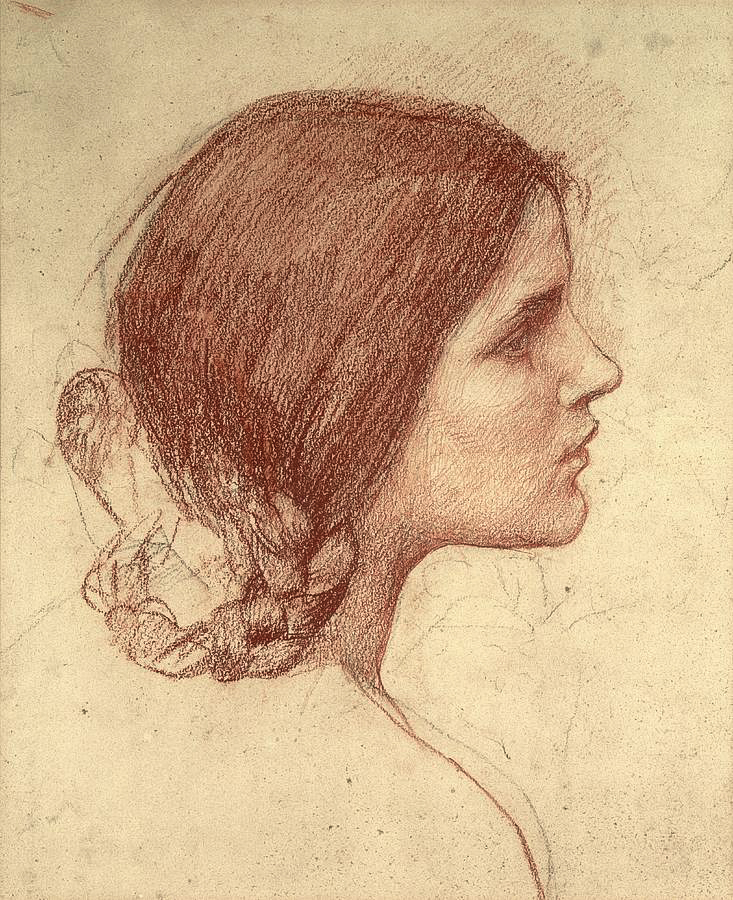
John William Waterhouse - Study of a girl's head
Study of a girl’s head, red and black chalk, on buff paper, 37.5 x 31.1 cm.

As Christopher Wood remarked in 1981 ‘One cannot help speculating about the identity of the mysterious and beautiful model who reappears so often in …Waterhouse’s pictures’ C. .Wood, The Pre-Raphaelites, London, 1981). In the early years of Waterhouse’s career it appears that his sisters, Jessie and Mary, and his wife, Esther, fulfilled the role of artist’s model; however once he became an established painter, three other women seem to have become his regular models.

The most consistent of these was Miss Muriel Foster, and it is possibly her features that we see in the present drawing. Her name is known from a single inscription on a pencil sketch for Lamia, 1905 (private collection); however her face is perhaps one of the best known in Pre-Raphaelite art. If we look at the characteristic tilt of the model’s long neck, her slightly pointed chin, fractionally upturned nose, delicately modelled lips and loosely plaited hair, we can see the face of the woman who appears in some of Waterhouse’s most famous paintings. She is recognisable in La Belle Dame Sans Merci, 1893 (Hessisches Landesmuseum, Darmstadt), Psyche opening the Door into Cupid’s Garden, circa 1900, (Harris Muesum and Art Gallery, Preston), and A Mermaid, 1892-1900 (Royal Academy of Arts, London) amongst others.

Baker and Baker, ‘Miss Muriel Foster: The John William Waterhouse Model’, The Journal of Pre-Raphaelite Studies, 8, Toronto, Fall 1999, suggest that Muriel Foster sat for all Waterhouse’s paintings between 1893 and 1906 and again for those at the end of his life. Waterhouse’s two other models appear to have sat for fewer pictures than Muriel Foster. The dark intense features of one whose identity is still unknown appears in Circe Offering the Cup to Odysseus, 1891 (Oldham Art Gallery) and Circe Invidiosa, 1892 (Art Gallery of South Australia, Adelaide) and the slightly less elfin features of Beatrice Ethel Hackman are most likely depicted in the previous lot 3.

Although there is no evidence of anything other than admiration between the artist and his model, Waterhouse’s dedication to Muriel Foster as a sitter was extraordinary. It is thought that she is the same Muriel Foster who appears in a birth register at Greenwich in 1878, who trained as a nurse and remained unmarried until her death at the age of ninety-one. Although the model’s appearance varies frequently in terms of hair-colour and attitude, through the years we see her maturing under the artist’s brush. Her soft teenage features in his early works such as La Belle Dame Sans Merci become the sharper, clearly defined features of a woman in The Enchanted Garden, 1916-17 (Lady Lever Art Gallery, Port Sunlight), one of the last pictures that Waterhouse ever painted.

The softness and warmth of the red chalk used in the present drawing compliments the sensitivity of Waterhouse’s modelling. The use of this medium, instead of a harder graphite pencil, lends the study the depth and richness characteristic of his finished oils. Although we cannot be certain that the present drawing is of Muriel Foster, the beautiful intimacy of this chalk study appears to demonstrate the effortless tracing of a familiar face.

Source