The Lady Clare, 1900, oil on canvas, 76.2 x 60.96 cm.
The Lady Clare was a painting that Waterhouse planned in great detail, completing several study drawings before commencing the final painting. The artist paid particular attention to the facial features of the model despite having a great wealth of talent and experience in portraiture. Through comparison of the drawings with the final painting, you will be able to understand some of the elements of the process undertaken by Waterhouse, including amendments that he made prior to beginning this complex piece. The scene is inspired by a Tennyson poem, as with many of his paintings at this time.
The ballad was published in 1842 and tackles subjects such as romance, marriage and class. Waterhouse would sometimes produce multiple compositions from a single poem though he also took in ancient mythology in other pieces. Lady Clare is told of her true parentage and is unsure whether or not to reveal this to her betroved, who is now from a much higher class than her. Class remains a highly significant element of British society in the present day but was even more significant during Victorian times.
The artist features some beautiful detail on the model’s dress, with flared sleeves, a thin belt with metalwork an a light undergarment which is displayed around the neckline. He completes the look of innocence with a small flower in her hair and would always add colour to the cheeks to continue the feeling of beauty, charm and purity. Pale skin was common for all of his models, many of whom he used on several occassions.
Dante and Matilda, study (formerly called “Dante and Beatrice”), 1914 – 1917, oil on canvas, 49.5 x 61.9 cm. Dahesh Museum of Art
A Victorian painter of myth, poetry, and legend, Waterhouse is noted for his highly individual synthesis of English and French styles. His work explores intense and mysterious subjects which are characteristic of Pre-Raphaelitism presented in the more continental idiom of painterly naturalism. This unfinished picture reflects Waterhouse’s late interest in a Pre-Raphaelite thematic touchstone: the spiritualized love celebrated by the Florentine poet Dante Alighieri. The painting depicts the moment in Il Purgatorio, canto 28 when he encounters Matilda, who personifies the active life, as opposed to the contemplative life represented by his beloved Beatrice, who will subsequently lead Dante in his quest for transcendence. The two protagonists are separated by the river Lethe; on the right side where the poet kneels, nature is bleak and the trees barren, while on the left side the trees are flowering. The contrast suggests a passage from one state of being to another—from the sinful state of normal human existence to the spiritual purity that Dante will eventually attain.
Study drawing for Dante and Matilda (Victoria and Albert Museum)
The picture is clearly related to The Sorceress, an unfinished canvas by Waterhouse of circa 1911, which would itself more suitably be called Circe since it is inscribed with this title on the back and includes two animals, the victims of Circe’s charms, at the left (see Anthony Hobson, The Art and Life of J.W. Waterhouse, 1980, p.128, no. 182.) The attitude of the figures in each picture is almost identical.
Circe was a favourite subject with Waterhouse and other artists in the late Pre-Raphaelite tradition. Waterhouse’s main treatments of the theme are Circe offering the Cup to Ullyses (1891, Oldham; illus. Hobson, 1980, pl. 50; 1989, pl. 31) and Circe Invidiosa (1892, Adelaide; illus. Hobson, 1980, pl. 53; 1989, pl. 32).
The Crystal Ball,1902, oil on canvas, 120.7 x 87.7 cm.
In The Crystal Ball, we can see a large degree of Pre-Raphaelite influence in contrast to the Roman and classical influence that was typical of Waterhouse’s early career. The Crystal Ball‘s placing the figure close to the picture plane resembles the composition of many Pre-Raphaelite paintings. The figure of the woman is also enclosed in an interior space, with a window serving as the only contact with the outside world, a composition that we have seen again and again. Similarly, the appearance of the lady herself is familiar; she is appropriately Pre-Raphaelite in her contemplative downward gaze and strong yet beautiful jaw. Waterhouse’s use of a rich red color for the gown is also largely reminiscent of the Pre-Raphaelites’ use of bold, bright colors. Thus, the lady in The Crystal Ball emerges as a typically contemplative Pre-Raphaelite woman in many ways. Yet we are left to wonder what exactly the lady is contemplating. She could be contemplating the future or her destiny with the help of the crystal ball, but some aspects of the painting suggest something else. For example, the view from the window obscured by dark trees and the shadow cast across the lady’s eyes create a rather sinister effect. Then, the crystal ball in the painting appears to contribute to a darker supernatural theme. Looking at Waterhouse’s use of shape in the scene, circles are very prominent; the round table, the semicircular window and the arc of the chair contribute to the overall appearance of the room and seem to reflect not only the shape of the crystal ball but also its theme. In effect, Waterhouse’s use of shape instills the entire painting with an air of magic. Furthermore, the skull perched on the table gives the painting a macabre touch. Thus, it appears as though the lady could be more sininster than a traditional contemplative woman. She may in fact be casting a spell which is further indicated by the open book, which could be a book of spells, next to the skull on the table. In this way, the young lady can be compared with the witch, Circe, another of Waterhouse’s subjects.
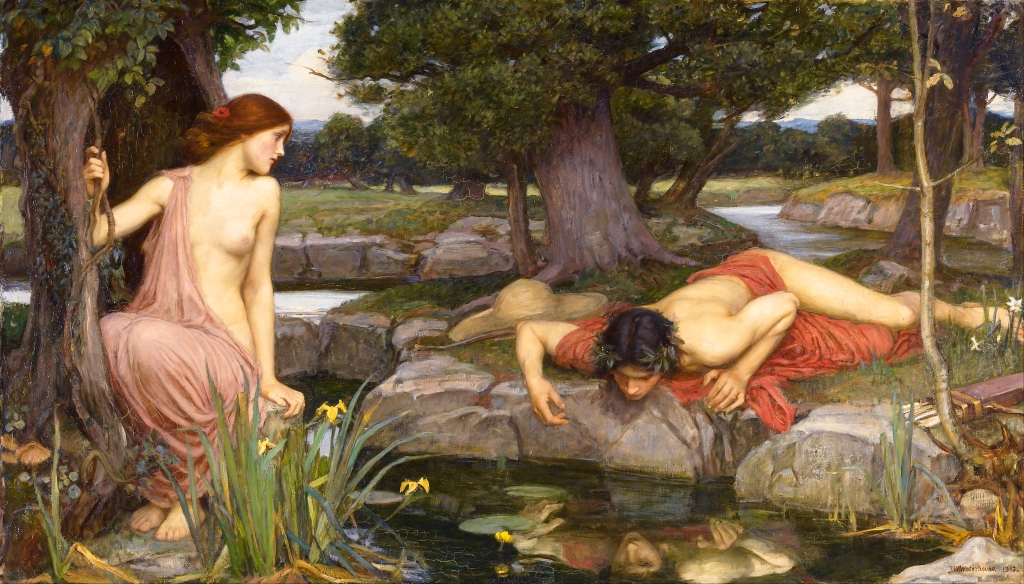
Echo and Narcissus, 1903, oil on canvas, 109.2 x 189.2 cm.
Narcissus was the son of the river God Cephisus and nymph Lyripe. He was desired by both men and women because of his youthful beauty. One admirer was the young man Aminias. He professed his love for Narcissus but was rejected by him. Aminias later killed himself out of grief and anger, begging the gods to teach Narcissus a lesson. They devised the ultimate revenge. One day soon after, Narcissus is said to have come across a pool in the woods. When he leant down to drink from it, he saw the most beautiful figure in the water’s reflection. He fell instantly in love with the youth, not realising it was his own reflection. Narcissus ultimately dies from sorrow on the banks of the pool, gazing longingly at his own reflection, heartbroken that his love cannot be returned by his reflection.
The story of Narcissus has traditionally been interpreted as a warning against pride and self-love. It is important for LGBT history too. Narcissus’s beauty attracts the attention of both men and women, mortals and gods. The Ancient Greeks were comfortable with the idea that sexuality was fuelled by attraction and desire, not necessarily by gender.
The Soul of the Rose, 1908, oil on canvas, 88.3 x 59.1 cm.
The Soul of the Rose was painted when Waterhouse was in his creative maturity; an artist established with patrons and public alike, who pursued his unique vision whilst adapting to modern precepts regarding style. Archetypally romantic, it is nevertheless executed with fluidity and verve, and leaves the crystalline imagery of the past century behind. Waterhouse’s title is loosely derived from Chaucer’s dream poem, Romaunt of the Rose, itself adapted from the 13th Century French romance: Roman de la Rose by Guillaume de Lorris. The narrator embarks on a pilgrimage with the god of love, who leads him to a rose symbolising perfect love. The poem had been treated by Waterhouse’s early mentor, Sir Edward-Burne Jones, in preparation for a tapestry. He depicts the rose personified as a young girl in an oil entitled The Heart of the Rose, 1889 . She embodies the beauty of the sentiment represented, and becomes a love object for the young poet.
Waterhouse’s interpretation is characteristically ambiguous, perhaps linked only in terms of its generic medievalism. His lovely protagonist leans forward to smell a rose. Her half-closed eyes suggest a degree of elective power, as if she hopes that the flower’s scent will body forth some desired secret. Though she may still represent the object of another’s desire, we are also invited to imagine her psychology, and to suppose a hidden narrative of thwarted or aspiring love. She is a participant rather than a passive symbol.
Waterhouse’s setting appears to be a walled Tuscan garden, evocative of paintings by 14th Century artists such as Fra Angelico. Both landscape and cultural heritage would have been familiar to Waterhouse who was born in Rome and returned to Italy during his student years. The paradox of the cloistered garden – something abundant yet enclosed suits Waterhouse’s theme well. Just as the rose’s scent acts as a heady agent, emblematic of love’s intensity, the limits of the garden reflect the concentration of experience implied by the story.
A study for The Soul of the Rose bears little resemblance to the finished picture; showing a dark-haired girl, plainly dressed, leaning up to smell the flower. In executing the present oil Waterhouse wrought his conception into something truly majestic; the model’s red hair, brocade gown, and comparative maturity (she is a young woman, not a girl) associate her more naturally with the courtly love tradition progenitor of both Chaucer’s poem and its French source.
The picture belongs to a series of single figure images rendered in the early 1900s, featuring dark or red-haired models. Scarce documentation makes it frustratingly hard to identify Waterhouse’s sitters. Critics have commented upon their vitality, compared for example to Burne-Jones’ more lifeless ideal. The red-haired beauty in The Soul of the Rose may be Miss Muriel Foster, who sat for Waterhouse on a number of occasions. A monochrome sketch depicts her in profile.
The angle of the model’s head and neck recurs, motif-like, throughout Waterhouse’s oeuvre; for example in Ophelia (1894) and Mariana in the South (1897). It is interesting to consider this in relation to George Frederic Watts’ portrait of his young bride, Ellen Terry: Choosing (1864). The picture, a Royal Academy exhibit, would have been familiar to Waterhouse as it belonged to his great patron, the financier Alexander Henderson, later the first Baron Faringdon. Faringdon first took Waterhouse under his wing in 1901, and introduced him to his younger brothers: Mr H.W. Henderson and Mr (later Sir) Brodie Henderson. Between them they purchased more than 50 paintings. The Soul of the Rose was in the collection of Sir Brodie Henderson.
The Faringdons’ patronage was well-timed. In the early 1900s change was afoot in the arts. Waterhouse’s romantic visions seemed overly idealistic to strident modernists. However, he inspired some loyal adherents. A.L. Baldry, in his 1911 piece for the Studio, wrote: ‘The modern feeling is evident enough in his work, but it is an intellectual modernity that he professes and one that he applies in a manner markedly individual’. Baldry was presumably referring to Waterhouse’s pictorial alphabet, which could never be mistaken for anyone else’s. Such individuality equalled modernity. Rose Sketchley, in her 1909 piece for the Art Annual, developed a redemptive interpretation of Waterhouse’s arcadian imagery: seeing ‘the analogy of the unfolding of the rose through earth, as the soul through suffering’. Her focus on the educative power of experience is essentially a reworking of the age-old theme of knowledge gained at the expense of innocence, couched in metaphysical terms in keeping with the 20th Century obsession with individual psychology.
It is perhaps wrong to overcomplicate Waterhouse’s thematic association of women with flowers. From images of metamorphosis (see Apollo and Daphne, 1908) to the ‘Persephone’ series (see The Song of Springtime, 1913), Waterhouse’s main thesis linked women and nature through the concept of regeneration. If his theme was long-established, however, his technique was modern, and had evolved considerably over the years. Early pictures such as Saint Eulalia (1885) are glacial, polished – very much in the manner of Sir Lawrence Alma-Tadema. In contrast, viewed from a stylistic point of view, the artist’s late work relates directly to the French Barbizon school and its British counterparts. Impressionistic in feel, it exploits the clash of colour and texture apparent when materials are viewed en plein air.
Indeed, The Soul of the Rose shows Waterhouse balancing detail and abstraction, precision and softness, with consummate skill. The background building, for example, is realised with little tonal depth, to render it subsidiary to the foreground figure. Where Waterhouse wishes our eye to focus – for example on the model’s hands he works with deft exactitude. It is his sensuous, instinctive, handling of his medium, coupled with the luminosity of his romantic heroines, which ensures the essential timelessness of Waterhouse’s art.




 John William Waterhouse