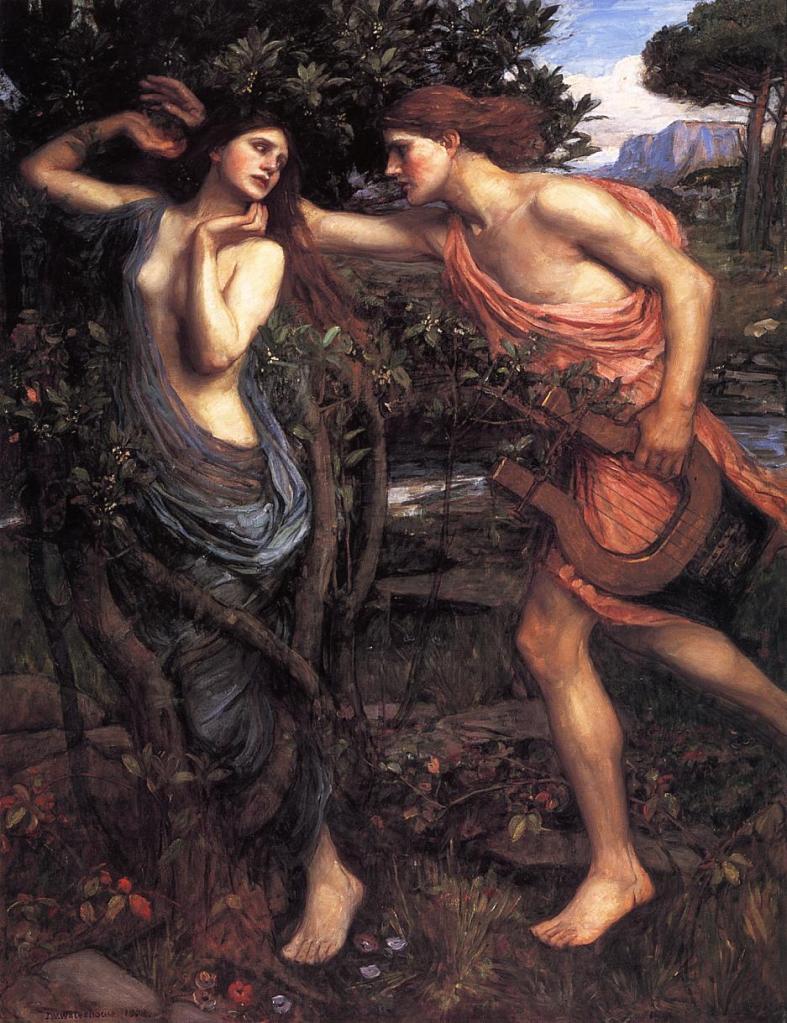
Apollo and Daphne
painting

Thisbe depicts a scene from one of Waterhouse’s favorite sources, Ovid’s Metamorphoses. In Book IV, the Roman author sets his story in ancient Babylon, where the maiden Thisbe falls in love with her neighbor, Pyramus. Their parents forbid the relationship, forcing them to exchange vows of fidelity through a crack in the wall shared by their families’ houses. The couple decide to elope with tragic consequences; agreeing to meet at Ninus’s tomb, Thisbe arrives first, but flees when she sees a lioness approaching. Pyramus subsequently arrives and finds the tracks of a lioness and Thisbe’s shawl. Believing that Thisbe is dead, Pyramus thrusts his sword into his belly, killing himself. Thisbe returns, sees what has happened, and also kills herself, their blood reddening the fruit of the white mulberry bush at which they were to meet; hence mulberries acquire their distinctive hue in perpetuity.
The story’s familiarity to English-speaking audiences was assured in the late 1300s by Geoffrey Chaucer, who included Thisbe in his Legend of Good Women, a tribute to past heroines who have suffered for love. (In view of his Romantic taste for melancholy, it is no accident that Waterhouse painted five of these figures: not only Thisbe, but also Cleopatra, Medea, Ariadne, and Phyllis.) British audiences were re-introduced to Thisbe by William Shakespeare, who wove her tale into the burlesque performed by Bottom and his friends in Act V, Scene I of A Midsummer Night’s Dream. The most relevant passage is:
‘O wall, full often hast thou heard my moans,
For parting my fair Pyramus and me!
My cherry lips have often kiss’d thy stones,
Thy stones with lime and hair knit up in thee.‘
And in that same year of 1595, Shakespeare reworked the tragedy of Pyramus and Thisbe into Romeo and Juliet, transferring the action to medieval Verona.
Their story suited Waterhouse ideally not only for its pining woman and theme of love unfulfilled, but also for the botanical metamorphosis that closes it. Ostensibly, the doomed couple live on even now in the beauty of the mulberry bush, just as other Waterhouse women became eternal natural forms. Painted in the same decade as Thisbe, for example, Echo fades into sound as she admires self-absorbed Narcissus (Echo and Narcissus, 1903); Phyllis emerges from her almond tree to forgive Demophoön (1907); and Daphne becomes a laurel tree as she flees Apollo (1908).
It is significant that Thisbe was first exhibited publicly in the spring of 1909. Only six months later, the critic Rose Sketchley published in the Christmas number of The Art Journal the most insightful analysis of Waterhouse’s art to appear during his lifetime, one surely prepared in close consultation with him. Sketchley writes that that this ‘is art which for its appreciation needs at least a capacity for realizing the alliance between our thought and the romantic vision gathered in literature from Homer to Tennyson. The conformity of the artist’s mind to that vision is unusually close; his sense of the past is, indeed, a poetical sensation.
For those who might find all these suffering women depressing, Sketchley a woman working as a journalist while others of her sex struggled for the vote—offers an intriguing take: ‘Like human flowers are these figures, in their harmonious sceneries. Others, ‘Psyche,’ ‘Pandora,’ ‘Isabella,’ ‘Lamia,’ ‘Mariana in the South,’ and especially ‘The Lady of Shalott’… are images of life forced in upon itself. Types, these, though still flower-like, of the analogy between the unfolding of the rose through earth, and of the soul through suffering.’ (op. cit., p.23.) Waterhouse, then, saw Thisbe and her fellow ‘victims’ ultimately as victors, a vantage in keeping with the Romantic temperament of Shelley, Keats, and Tennyson, whose narratives he also depicted.
Sketchley’s mention of the Lady of Shalott is crucial. Note that Thisbe has just risen from the loom behind her; indeed, we can readily admire the skill of her weaving in the glorious red robe and beige sash she wears. Waterhouse’s generation equated needlework with feminine virtue and domesticity, as the Virgin Mary was believed to have embroidered. From the 1880s onward, Waterhouse showed women who weave well (e.g., the Lady of Shalott, Circe, Penelope). Biographically speaking, this surely reflects his admiration of the fact that his mother, aunts, step-sister, and wife were all painters (and possibly weavers, too). Moreover, around the time Thisbe was painted, Waterhouse taught part-time at the King’s College School of Art for Women. This was a man who clearly believed in female artistry.
More significantly, Sketchley allays any suspicion that Thisbe’s loom is merely a sign of domesticity. Rather, the journalist underscores Waterhouse’s reverence for “the embroidery of Persephone,” in which the ‘bloom and glow of color were interwrought with the design of the ordered elements: the concretion of solid earth in the midst of the blazing firmament, the rhythmic forthflowing of the sea. With star-gold, purple of waters, and the clear hues of flowers in the grass, the goddess enriched her web, singing as it brightened. (op. cit., p.1.)
Sketchley writes that ‘the general mind has lost kinship with the sentiment of mythology. To see itself in the guise of myth and legend, it has need of interpreters to whom classicism and medievalism are no merely formal modes of thought. Art pre-eminently—since it seeks in antiquity not the form which perishes, but the spirit which is perpetual life—has power to interpret to our consciousness that colored imagery of the past, to make it reveal anew its assurance of the ideal in the actual. In myth and legend especially, those heartfelt forms of belief and hope, there is, for each age, the reflection of its own questing spirit; a reflection that it is well we should be enabled to see, for it reconciles the working of our troubled minds with a mode of beholding that is as ‘fire to reach to fire.’’ (loc. cit.)
Waterhouse, in this context, was a seer, helping his fellow Edwardians find solace in the philosophical and poetical beauty of myths and legends. It is no accident that he was, when Thisbe appeared, hard at work on a large series of paintings that shows young women picking flowers in a vale. Surely these represent Persephone just before Hades drags her down to the underworld. Like Thisbe, she is a soul who triumphs through suffering.
Having risen from her loom, loyal Thisbe ignores the sunny garden beyond with its staircase, a characteristic Waterhouse device that gives the composition its necessary sense of recession while also conveying the comparative darkness of this miserable chamber. The female model is Waterhouse’s favorite of this period, who is unfortunately still not identified by name; she appears with a similarly haunted expression (though endowed with red tresses) in the following year’s Ophelia, and three years later in Penelope and the Suitors featuring the same striking disjuncture of pale skin and dark black hair.
Waterhouse did not bother to research the archaeological remains of ancient Babylon: the little stool in the foreground is actually Egyptian, as are the lotuses adorning Thisbe’s gown. The forms that punctuate the window’s transom in the background of the composition are Islamic, the tiles lining the right-hand wall are Ottoman, and the opus sectile flooring is late Roman. Incorrect though they may be, they converge successfully to suggest an exotic, distant past.
It is, however, the brilliantly colored gown painted with Waterhouse’s beloved lake pigments—that captures our eye and drives it upward to Thisbe’s face, moving along the perfectly designed triangle formed by her arm and head. Triggered by the whispers of Pyramus, the pink flush on her face picks up the robe’s coloring, making the girl’s pallor all the more alarming and alluring.
Other artists of Waterhouse’s generation depicted the story of Thisbe and Pyramus; Edward Burne-Jones certainly admired it, yet Waterhouse may well have been moved to paint it upon seeing Edwin Long’s 1875 vision of Thisbe, which was sold at Christie’s a year before the present picture appeared. Long’s treatment also showed Thisbe listening at the wall, but Waterhouse reverted to a more compelling pose at which he already excelled: this juxtaposition of a woman with a hard surface appears, for example, in Psyche EnteringCupid’s Garden (1903, Harris Museum and Art Gallery, Preston) and The Soul of the Rose (1908).
Thisbe was purchased in 1909 by the eminent barrister, art collector and bibliophile Lieutenant-Colonel Fairfax Rhodes (1845-1928). The son of a wealthy stockbroker, Fairfax Rhodes read law at Trinity College, Cambridge before being called to the Bar in 1870. From 1900 he lived at Brockhampton Park, Gloucestershire, where he housed his collection of paintings by contemporary artists, including Henry Scott Tuke’s 1908 masterpiece Midsummer Morning, and Waterhouse’s Ophelia of 1910.
After Rhodes’s death Thisbe entered the collection of William Randolph Hearst, Sr. (1863-1951), the multi-millionaire American businessman and newspaper magnate, who spent vast amounts of money on art and antiques in the 1920s and 1930s and is particularly well remembered for his creation, along with his aid and confidante, the architect Miss Julia Morgan, of San Simeon in California. In 1925 Hearst bought St. Donat’s Castle in South Wales for £45,000, and under the direction of Sir Charles Allom, the architect-antiquarian-decorator who had recently re-decorated Buckingham Palace for George V, the Castle was transformed in typical Hearst fashion. Large amounts of art and antiques originally destined for San Simeon were shipped to the United Kingdom for St. Donat’s (fig. 1)(it was said that a large part of the World’s tonnage was used in shipping Hearst’s purchases back and forth across the seas). In 1937 the Hearst Corporation was on the brink of insolvency and drastic measures were taken by a separately formed executive committee. Some of his thirty-seven newspapers were closed or sold off and part of his large art collection dispersed. St. Donat’s was put on the market in 1938, although a new buyer wasn’t found until 1960, nine years after Hearst’s death.
Thisbe and its companion piece of that year, Lamia were well received when they were exhibited at the Royal Academy in 1909. The Studio, noting ‘Mr. J. W. Waterhouse, an artist who aims consistently at a high order of poetic expression, is represented this year by two small pictures Thisbe and Lamia, which are delightful in their delicate and yet vigorous individuality and entirely attractive in their beauty of color’. The present painting by Waterhouse exemplifies his skill and fully displays the enduring appeal of his works. The key elements of Waterhouse’s art come together successfully in this picture – the heroine is beautiful, real and believable, his eye for color and detail are fully expounded as are his sense of composition and his instinct for focusing on the moment of stillness of the story on which the whole plot turns. The reappearance of this picture at auction after an absence of 30 years provides collectors, who admire Waterhouse’s artistry and keenly felt connection to such ancient stories of passion and transformation, with a rare opportunity to purchase one of Waterhouse’s iconic masterpieces.
– From Christy’s catalogue.


Cupid was sent by his jealous mother, the goddess Venus, to punish Psyche for her beauty. Instead, Cupid fell in love with Psyche but would only meet her after dark so she couldn’t identify him. Here, Psyche is trying to catch a glimpse of her secret lover in daylight. Sometimes called ‘the last Pre-Raphaelite’, Waterhouse used his lush, romantic style to paint many scenes from Greek and Roman mythology.


This painting was originally shown at the Royal Academy in 1911 along with The Charmer. Both paintings depict the strong power music can hold over its listeners. It is no wonder that they were both bought from the artist by Major Alec P. Henderson, who was a loyal patron to Waterhouse and collected many important works of his time including Edward Coley Burne-Jones’ Briar Rose series.
Listening to My Sweet Pipings is an example of Waterhouse portraying through facial expression and body juxtaposition a brooding sense of inner turmoil. The girl’s eyes do not look directly at the viewer, but are instead glazed over as she gazes off into her own thoughts. The same glassy stare can also be seen in Waterhouse’s paintings of Ophelia and also in the depictions of the Lady of Shallot. The mythical Pan, with eyes fixated on his companion, tries to occupy her mind through music. Peter Trippi, author of J.W. Waterhouse, states in the catalogue raisonné of the artist’s work that Waterhouse “took the title Listening to My Sweet Pipings from Shelley’s Hymn of Pan, in which the sylvan god pipes the world to sleep. Earth’s reclining figure repeats in form the colour the beautifully rendered sky, hills and water.”
John William Waterhouse painted a series of paintings that related woman to nature. Listening to My Sweet Pipings is probably the best known in this series. The woman in Listening to My Sweet Pipings can be interpreted to represent the whole of nature, as every aspect of it can be seen in this painting. She is nestled at its very heart, symbolized by the great diversity in the landscape. Waterhouse did not casually select this background, but very deliberately depicted the main mythological elements of nature such as: streams, forests, fields, mountains, and caves. Rather than being a nymph relating to one, she encompasses them all. The blue and pink fabric she is draped in reflects exactly the colors of the mountains behind her and the dark mauve sash around her waist is reminiscent of an umbilical cord connecting her to her mother Earth, and thereby to the viewers as well.
– Kara Ross

Isolde, Princess of Ireland, has been entrusted to the care of Tristram, the nephew of the king of Cornwall, to take her safely to Cornwall to marry the king. However, Tristram loves Isolde himself and Isolde loves him in return. Tristram and Isolde decide to die together rather then be separated and choose to drink a poison. However, unbeknownst to them the poison was switched for a love potion. After they both drink it they fall even more madly in love and run off together into the forest. Tristram (Tristan) and Isolde, is a legend depicted in many Victorian paintings.
Waterhouse captures the two lovers together on the boat just before drinking the potion, thinking they are about to die. The desperation in Isolde’s face can be clearly seen as she clutches the goblet with both hands. In Tristram we see a distinct look of resignation as he accepts it. Waterhouse also points out the separation that has been forced between them. They stand on either side of the painting with the cup and the bottle of potion between them. On Tristram’s side lies his helmet and sword with a rope coiled underneath. In the background the castle can be seen illustrating a tie to his duty in bringing Isolde safely to the king. On Isolde’s side sits a throne like chair symbolizing her duty to marry the king once she gets there. Also, there is a very distinct line representing a plank which runs between them, directly under the goblet, further emphasizing their separation. As Tristram accepts the cup his foot “steps over the line”, foreshadowing that the separation between them is about to end.
Waterhouse painted a second version of this painting entitled Tristram and Isolde, which has the bottle of potion behind Tristram and less of the castle visible. There is also a crown on Isolde’s head and a book which lies open at her feet. The edge of the plank separating the two is even more pronounced with Isolde actually appearing to be slightly elevated.
– Kara Ross

Waterhouse exhibited the painting with the following note: ‘“The Oracle or Teraph was a human head, cured with spices, which was fixed against the wall, and lamps being lit before it and other rites performed, the imagination of diviners was so excited that they supposed that they heard a low voice speaking future events.”’
If this is a quotation, its source is unknown. Teraphim were the idols or images which served as objects of reverence and divination among the ancient Hebrews and other kindred peoples; the word was chiefly used (as in the Old Testament) in its plural sense, but was occasionally contracted to a singular form, as in Southey, Thalaba, II, ix: ‘Khawla to the Teraph turn’d, “Tell me where the prophet hides our destin’d enemy?”’
In his treatment of the subject, Waterhouse concentrates (as so often) on the appearance of women under stress. Seven young girls sit in a semicircle about a lamplit shrine, reacting with various emotions to the suspense of waiting while their priestess, motioning them to silence, bends her head to catch the messages of a mummified head; but whether they wait for prophecies of war or of the marriage-bed is left in doubt. The exotic ‘middle-eastern’ setting is probably imaginary, derived from somewhere between J.F. Lewis’s Levant and Leighton House.

The free study on the recto of is probably Waterhouse’s first conception of the subject, broadly followed in the painting. The study of the same subject on the verso is more sharply focussed, and shows some changes (such as the fact that the second girl now buries her face in her hands) which were followed in the finished painting; but the intricate patterning of stuffs and the richly ornamental decor of the painting are barely hinted at in either study.
The second study on the verso appears to depict a Grecian rather than a Hebrew priestess, and probably represents the Pythia, through whose mouth spoke the oracle at Delphi, and who answered its consultants’ questions from a tripod throne. No painting by Waterhouse of this alternative oracle is known.

This is a study for the head of the enchantress Circe in Waterhouse’s painting of 1892 Circe Invidiosa (Art Gallery of South Australia, Adelaide), in which she is pouring a huge bowl of lurid green poison into the sea to transform her love-rival Scylla into a hideous monster.
This drawing and the following two studies by Leighton and Waterhouse were in the collection of Dr James Nicoll, medical superintendent of the Fountain Hospital in Tooting. His obituary stated that ‘his principal interests were his collections of paintings and porcelain. He bought extensively and made a hobby of tracing the history of his best pieces, seeking documents authenticating each article.’ (British Medical Journal, 7 February 1959)
– From Sotheby’s catalogue.
 John William Waterhouse