Head study for ‘The Enchanted Garden’, 1916, oil on canvas, 27 x 17.8 cm.
The Enchanted Gardenwas one of the final important contemporary paintings that the first Viscount Leverhulme, the millionaire Liverpudlian soap manufacturer, purchased. At Waterhouse’s death in 1917 it was incomplete, but it was exhibited at the Royal Academy later that year nonetheless, illustrating the artist’s importance at that time. It was sold by Waterhouse’s widow, Esther, to Leverhulme in 1922. The subject matter is taken from Boccaccio’s Decameron, a series of novellas written in the 14th Century, narrated by a group of young Florentines who tell stories to entertain themselves as they hide in isolation away from the Black Plague ravaging their city. The painting is now on view at the Lady Lever Art Gallery, alongside A Tale from the Decameron (1916), another large Waterhouse showing a group of Florentines in a verdant garden, and other masterpieces from the Leverhulme collection. Our head study is for the central female figure in the painting.
Gather Ye Rose Buds While Ye May, red chalk over pencil.
This particularly expressive drawing by Waterhouse appears to relate to a little-known version of ‘Gather Ye Rose Buds While Ye May’ a picture very different from the two paintings of that title painted in 1908 (Christie’s, 11 June 2003, lot 6) and 1909 (Christie’s, 27 November 2002, lot 12) but painted around the same time. In this version (private collection) a young maiden stands three-quarters turned to the left holding a bowl of roses with a beautifully painted walled garden behind. The first record of the existence of this drawing is its reproduction in that seminal journal of European art of the early twentieth century, The Studio. The drawing was illustrated to accompany an article devoted to Waterhouse’s drawing method and approach to figure drawing and demonstrated the striking simplicity of his drawings in comparison to the more elaborate oil paintings. Waterhouse’s drawings have a more immediate power of expression, capturing that fleeting beauty of youth and innocence without the distraction of the trappings of mythology or romance.
Study for a Nymph in Hylas and the Nymphs, 1896, charcoal, white chalk and pencil, 42 x 32 cm.
This recently rediscovered drawing was made in preparation for one of Waterhouse’s most famous paintings, Hylas and the Nymphs (Manchester City Art Gallery) painted in 1896 and exhibited at the Royal Academy in 1897. The picture depicts a wooded glade and a pool clogged with lilies, from which a group of naked water-nymphs rises to tempt a young man into the black waters. The narrative was taken from the thirteenth Idyll of the poet Theocritus, describing the story of the beloved companion of Hercules, Prince Hylas, son of King Theiodamas of the Dryopians. Hylas and Hercules travelled on the Argo with Jason and the Argonauts in their quest to find the Golden Fleece. On their return from Colchis with their prize of the Golden Fleece and with Princess Medea, the Argonauts stopped at Mysia and Hylas was sent to find water at the spring of Dryope. ‘He was seized, they asserted, by the nymphs of the stream to the banks of which he had strayed; and was lost to human haunts because these water goddesses, enamoured of his beauty, kept him a prisoner beneath the waters.’ (‘Hylas and the Nymphs’, Studio, Vol. 10, May 1897, p.244)
In Theocritus’ narrative, the number of nymphs is not specified and other classical sources of the myth, including those given by Ovid and Apollonius Rhodios, suggest that there was only one naiad (the Greek word for a water-nymph). Waterhouse chose to surround his prince with seven nymphs, the same number of sirens that surround Ulysses’ ship in his first major painting depicting mythological femme-fatales, Ulysses and the Sirens of 1891 (National Gallery of Victoria, Melbourne). For each of the youthful nymphs Waterhouse made drawings from favourite models; one study depicts the two girls on the far right (Ashmolean Museum, Oxford) whilst another depicts the girl in the centre lifting her hair (private collection). The present drawing depicts the girl holding out pearls to Hylas in the painting, her apologetic expression being typical of the artist’s seductresses who are deadly but reluctant and repentant.
Although the painting was generally warmly-received by the critics and has continued to be one of the artist’s most popular pictures, the correspondent for The Times (1 May 1897, p.10) criticised the fact that the nymphs all looked alike. This is rather unfair as, although they share a similar ‘look’, they are individually beautiful. Elizabeth Prettejohn has suggested that; ‘Drawings and close study of the faces, suggest that Waterhouse may have used at least two models, but the uncanny resemblance among the faces is crucial to the hypnotic power of the scene, and its supernatural resonances.’ (J.W. Waterhouse – The Modern Pre-Raphaelite, exhibition catalogue for the Groninger Museum, Royal Academy and Montreal Museum of Fine Arts, 2008-2010, p.134)
Waterhouse painted subjects of powerful emotion and drama, often with an erotic charge. The expressions of his women are beguiling and intense, as demonstrated by the mesmerising eyes of the girl in this drawing. His subjects were usually romantic and sometimes tragic and in the hands of a lesser artist the narratives could be cloying and sentimental. However his way of painting and drawing was energetic, modern and robust and his pictures are always enlivened by much more than a desire to paint pretty subjects. This draughtsmanship in this drawing demonstrates his great artistic spontaneity. There is nothing hesitant or lacking in conviction in his pencil strokes and he has set down no more than he needs to convey the grace of the figure and the face. As Anthony Hobson observed; ‘Waterhouse left a large number of superb drawings of heads, and this constant practice suggests that the personality of the model was one of his major sources of inspiration.’(Anthony Hobson, JW Waterhouse, 1992, p.57) The identity of the models who posed for Waterhouse has been the subject of much speculation. Several names have been suggested but as the faces that appear in the paintings of the 1890s closely resemble those from the late 1910s without aging, it is likely that Waterhouse chose a series of models who conformed to a particular type of physiognomy.
‘You start in April and cross to the time of May One has you as it leaves, one as it comes Since the edges of these months are yours and defer To you, either of them suits your praises. The Circus continues and the theatre’s lauded palm, Let this song, too, join the Circus spectacle.‘
– Ovid, Fasti (V.185-190)
A beautiful young maiden is seated on a marble bench beneath a vine of grapes and beside a roadside shrine. She has been arranging irises and narcissi as offerings to the Roman goddess of flowers and gardens Flora, identified by the bronze votive statue of a garlanded female figure. She holds a heart-shaped fan in her hand and from her dreamy expression and blushed cheeks it seems that she has been distracted from her task by a romantic daydream. It was the connection between girls and flowers that was to become the predominant theme of Waterhouse’s oeuvre, in paintings of Persephone and her handmaidens wandering through verdant flower-filled meadows and of the goddess Flora herself being abducted by a wind god amid voluptuous flower blooms. In the Roman pantheon of gods and goddesses Flora was a relatively minor fertility deity, who personified the coming of spring. It is likely that Waterhouse’s maiden is celebrating the Floralia (Florifertum) festivities of April and May when the flowers he chose to depict are in bloom and the grape vines are bare of fruit. The festival began in Rome in 238 B.C. to persuade the goddess Flora into protecting the blossoms, but fell out of favour and was discontinued until 173 B.C., when the Roman senate, concerned with wind, hail, and other damage to the flowers, ordered that Flora’s celebration be reinstated. At this time the festival was known as the Ludi Florales and was celebrated by the decorating of shrines, the wearing of floral wreaths and casting of flowers in the streets and culminated in the sowing of seeds and releasing of animals in the Circus Maximus. During the Floralia, the people of Rome wore colourful costume rather than their usual white dress and Waterhouse may have been alluding to his with the golden stola (a classical item of dress used to hold women’s togas in place) tied in a bow tied around the girl’s waist to brighten her otherwise modest costume. The fact that she is barefoot perhaps suggests that she has already begun to dance to the music of the Floralia.
The most famous Victorian painting of the Floralia festivities is Lawrence Alma-Tadema’s Spring (John Paul Getty Museum, Malibu), a painting that took him four years to complete and became one of his most famous paintings. Unlike Alma-Tadema who painted an exuberant crowd scene, Waterhouse pared the subject to a quieter and more intimate composition, concentrating on the calm young girl and her solitary devotion. The two modern experts on Waterhouse’s work have described Flora as ‘calmly beautiful’ (Anthony Hobson, J. W. Waterhouse, 1889, p. 41) and possessed of ‘much of the technical charm of Alma-Tadema, yet with a greater vitality’ (Peter Trippi, J. W. Waterhouse, 2002, p. 99).
Flora was one of a small number of paintings that were inspired by a trip made by Waterhouse to the island of Capri in 1890, when he made sketches for paintings, the most famousbeing An Alfresco Toilet which was in the collection of the soap manufacturer Lord Leverhulme. The sojourn was probably financed by the sale of two of Waterhouse’s most acclaimed paintingsOphelia (Lord Lloyd Webber collection) andThe Lady of Shallot(Tate) both painted in 1889. It is likely that although studies for the background of Flora were been made on Capri, the figure drawings were made after Waterhouse’s return to his London studio. The model that posed for the painting was the delicately-featured young girl that entered Waterhouse’s art around this time. This unnamed model had the most profound influence upon the artist’s ideal of feminine beauty and possible names have been suggested for her, a firm identification has not yet been proved. Her first appearance was probably for Ophelia of 1889 (it has been suggested that the model for The Lady of Shallot was the artist’s sister Jessie) and it is undoubtedly her features that appear in the series of pictures of the 1890s, including Circe Invidiosa (Art Gallery of South Australia, Adelaide) and Danae (present whereabouts unknown) of 1892, A Hamadryad (Plymouth Art Gallery) of 1893, St Cecilia (Lord Lloyd Webber collection) of 1895, Pandora (Lord Lloyd Webber collection) and Hylas and the Nymphs (Manchester City Art Gallery) of 1896. For Flora Waterhouse painted the gamine young model dressed in a white toga of thin cotton that reveals tantalising glimpses of her breasts and long pale legs beneath, creating a subtle eroticism which simultaneously suggests virginal purity and alluring beauty. The painting depicts the budding beauty of womanhood and young love amid a beautiful setting suggestive of sunshine and warmth.
The overall composition and subject of Flora was based upon Waterhouse’s Offerings which was exhibited at the Dudley Gallery in 1879. The subject of devotional sacrifice was also pictured in The Household Gods of 1880 (Private collection) which was part of the collection of the famous engineer Sir John Aird, and presumably also Sweet Offerings exhibited at the Liverpool Autumn Exhibition in 1882 (Private collection). In 1890 Waterhouse returned to the subject of young girls making offerings of flowers at public shrines and painted the present picture and at least two versions of a composition entitled Arranging Flowers of c.1890. The same lissom young red-haired model was used for Flora and Arranging Flowers dressed in a loose toga tied at the waist and with bare feet. In 1895 she also posed for a medieval variant of the theme entitled The Shrine (Private collection).
The first owner of Flora was the artist Luke Fildes, who exhibited The Doctor (Tate) in 1890, the same year that the present picture was painted. The critical success of The Doctor brought Fildes immediate fame and wealth and it seems that Flora was one of his first purchases he made to celebrate his new-found success.
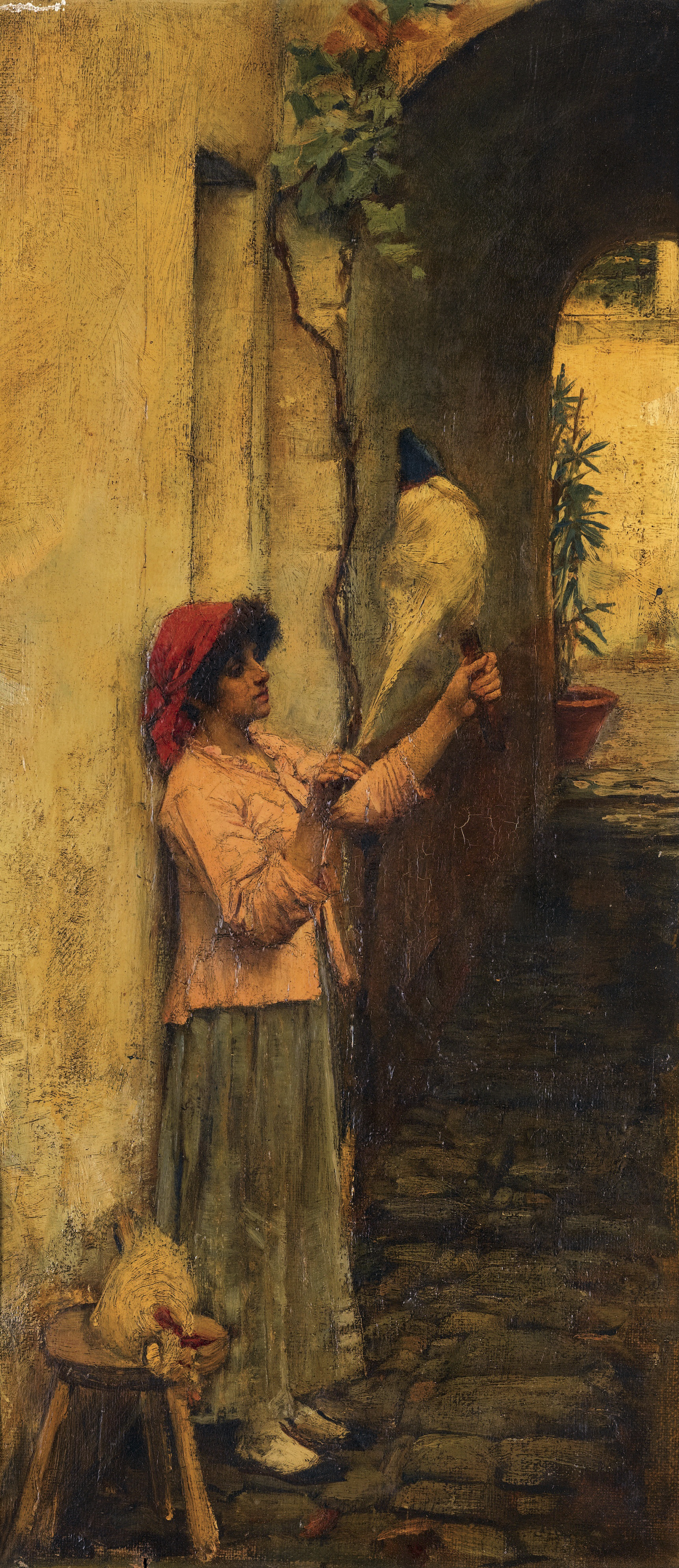
A Neapolitan Flax Spinner, 1877, oil on canvas, 41 x 19 cm.
Neapolitan Flax Spinner was probably painted during Waterhouse’s visit to southern Italy in 1877 when he also painted several watercolours at Pompeii. Although he had been born in Italy, his parents had moved to England when he was five years old and the trip in 1877 was the first time he had returned. This picture is a rare early painting by Waterhouse. Unlike other pictures of this formative period such as In the Peristyle of 1874 (Rochdale Art Gallery), After the Dance of 1876 and A Sick Child Brought into the Temple of Aesculapius of 1877 (both from the collection of Sir Tim Rice), this picture depicts a contemporary scene of Italian peasant life. However, the picture appears to have been based on an earlier, classically-inspired subject La Fileuse of 1874 (Bonhams, 29 September 2010, lot 143) which also depicts a flax spinner at the door of her house.
The favourites of the Emperor Honorius study, oil on board, 20 x 28 cm.
This is an early sketch for Waterhouse’s painting of 1883 (Art Gallery of South Australia, Adelaide), the first of his pictures to be bought by a public art gallery. It is thought to be an illustration to Wilkie Collins’ novel Antonina; or, The Fall of Rome written in 1850. The Favourites of the Emperor Honorius depicts the emperor Honorius (reigned 395-423A.D.) at his palace at Ravenna, idly feeding his pet guinea-fowl and doves with little regard for his besieged people at Rome. In the background is the figure of an imperial guard and the sketched figures of Honorius’ courtiers.
Nymphs finding the head of Orpheus: the head of Orpheus, oil on canvas, 49 x 90 cm.
‘Waterhouse’s imaginative power is emphasized by the floating head with its hair entwined in the floating lyre; in reality, this grouping would keep the two objects together, but here it also alleviates the stark horror of the disembodied head. Notice, too, the final accent of the flower placed centrally among the hair.’ (Anthony Hobson, J. W. Waterhouse, 1980, p. 117) The present painting relates o Waterhouse’s Royal Academy exhibit of 1901 Nymphs Finding the Head of Orpheus, painted in 1900 in which two female deities have happened upon the head of the musician floating in the river Herbrus where they are fetching water. Following Orpheus’ loss of his wife Eurydice, he roamed the land inconsolable and absorbed by his grief and his refusal to concede to the advances of the Thracian Bacchantes incurred their terrible wrath. After his frenzied murder, his severed head was cast into the river with his lyre and as he water lapped over the strings of the instrument, it played a mournful tune to the accompaniment of his singing which continued even after death. The subject was one that was popular in fin de siècle Europe, in the work of the likes of Odilon Redon, Gustave Moreau and Jean Delville and of all Waterhouse’s paintings The Head of Orpheus is perhaps Waterhouse’s most Symbolist, transcending a purely narrative subject and embodying the eternal spirit of music.
The concentration upon the head of Orpheus with the harp in the present painting is arguably more powerful than the finished painting, as it centres upon the theme of melancholic music without the distraction of the auxiliary nymphs. Anthony Hobson has explained the importance of this picture in the evolution of Nymphs Finding the Head of Orpheus; ‘The apparently effortless nature of the painting, to which Waterhouse’s mastery of the figure contributes, is belied by such detailed analysis. The time and thought devoted to it are attested not only by the preliminary pencil and oil sketches showing significant differences in the composition, but by a full-scale study in oils of the floating head, comparable in treatment to the finished work.
Study for the head of Venus in the ‘Awakening of Adonis’, oil on canvas, 49 x 36 cm.
Waterhouse’s great mythological subject The Awakening of Adonis (Collection of Lord Lloyd-Webber) was painted in 1899, but was not finished in time to send to the Royal Academy that year, and was therefore held over to the summer exhibition of 1900. On that occasion it was recognised as one of the artist’s most powerful and characteristic works and one that aimed, in the words of one reviewer, ‘at representing the passionate emotions of an historic tragedy in a highly dramatic fashion’ (Athenaeum, 1900, p.568). The painting may be seen as one in a series of spectacular and challenging works by Waterhouse, each of which show moments of fateful confrontation between the gods and mortals of Greek and Roman legend, and may be compared to Hylas and the Nymphs (Manchester City Art Gallery) and Flora and theZephyrs (offered in these rooms, 6 November 1996, lot 307), of 1896 and 1897 respectively. The series ended with the painting Nymphs Finding the Head of Orpheus (private collection), exhibited in 1901, the year after The Awakening of Adonis.
The Awakening of Adonis takes its subject from the ancient fable, retold by Apollodorus, Hyginus and Ovid, which tells how Adonis was the child of Myrrha and her father Theias, the king of Syria. The goddess Venus had encouraged this incestuous union and, when Adonis was born from the trunk of the myrrh tree into which his mother had been transformed, it was she who took care of him, entrusting him to Persephone, goddess of the Underworld. The child grew up to be so beautiful that Persephone found that she could not bear to return him to Venus, leading to a dispute between the two. This was settled by Zeus, who decided that Adonis should spend four months of the year with Venus and another four with Persephone. The remaining third of the year he might spend with whichever of the two goddesses he preferred. Venus used the power of magic to cause him to want her rather than Persephone. In Waterhouse’ painting the beautiful boy is awakened with a kiss from Venus in her Elysian pleasure-garden. Cupid, the god of love, blows on a torch to rekindle a flame, and is accompanied by a band of putto holding flowers. White doves take to the air and the garden is fecund with roses (symbols of Venus) and anemone flowers that were said to grow from the blood of the dying Adonis. The mythological legend of Adonis, as represented in the present painting, is therefore symbolic of the renewal of life, vigour, and desire at the arrival of spring.
The present sketch demonstrates Waterhouse’s vigorous and confident way of painting, the head of Venus appearing to evolve from the expressive brushstrokes of paint. He had reused a canvas bearing the sketch for the putto on the far left of the finished painting’s composition. When the sketch was sold at Christie’s in 1926, following the artist’s death its connection to The Awakening of Adonis was not recognised and it was titled A Wood Nymph.
The Awakening of Adonis, 1899, oil on canvas, 95.89 x 187.96 cm.
Waterhouse’s great mythological subject The Awakening of Adonis (Collection of Lord Lloyd-Webber) was painted in 1899, but was not finished in time to send to the Royal Academy that year, and was therefore held over to the summer exhibition of 1900. On that occasion it was recognised as one of the artist’s most powerful and characteristic works and one that aimed, in the words of one reviewer, ‘at representing the passionate emotions of an historic tragedy in a highly dramatic fashion’ (Athenaeum, 1900, p.568). The painting may be seen as one in a series of spectacular and challenging works by Waterhouse, each of which show moments of fateful confrontation between the gods and mortals of Greek and Roman legend, and may be compared to Hylas and the Nymphs (Manchester City Art Gallery) and Flora and theZephyrs (offered in these rooms, 6 November 1996, lot 307), of 1896 and 1897 respectively. The series ended with the painting Nymphs Finding the Head of Orpheus (private collection), exhibited in 1901, the year after The Awakening of Adonis.
The Awakening of Adonis takes its subject from the ancient fable, retold by Apollodorus, Hyginus and Ovid, which tells how Adonis was the child of Myrrha and her father Theias, the king of Syria. The goddess Venus had encouraged this incestuous union and, when Adonis was born from the trunk of the myrrh tree into which his mother had been transformed, it was she who took care of him, entrusting him to Persephone, goddess of the Underworld. The child grew up to be so beautiful that Persephone found that she could not bear to return him to Venus, leading to a dispute between the two. This was settled by Zeus, who decided that Adonis should spend four months of the year with Venus and another four with Persephone. The remaining third of the year he might spend with whichever of the two goddesses he preferred. Venus used the power of magic to cause him to want her rather than Persephone. In Waterhouse’ painting the beautiful boy is awakened with a kiss from Venus in her Elysian pleasure-garden. Cupid, the god of love, blows on a torch to rekindle a flame, and is accompanied by a band of putto holding flowers. White doves take to the air and the garden is fecund with roses (symbols of Venus) and anemone flowers that were said to grow from the blood of the dying Adonis. The mythological legend of Adonis, as represented in the present painting, is therefore symbolic of the renewal of life, vigour, and desire at the arrival of spring.





 John William Waterhouse