Phyllis and Demophoön, 1905, oil on canvas, 136.5 x 91.5 cm.
As with his treatments of Ariadne (1898), Medea (1907), and Penelope (1912), Waterhouse took as his source a narrative from Ovid’s Heroides, a volume of poems recounting the ordeals that various women endure on account of the actions (or inactions) of men. After the conquest of Troy by the Greeks, the hero Demophoön, King of Athens and son of Theseus, during his journey home visited the Thracian court, where he fell in love with the Thracian king’s daughter, Phyllis (perhaps we should have expected trouble to ensue, for his father Theseus had previously deserted Ariadne, daughter of the Cretan King Minos, on the island of Naxos). Demophoön falls in love with Phyllis and they agree to marry, but Demophoön is duty bound to return home and so departs, promising to return for Phyllis. Phyllis presents him with a casket asking him only to open it when he has given up all hope of returning to her. When he fails to keep his promise, one tradition has it that Phyllis hangs herself in despair and the gods take pity on the unfortunate girl transforming her into an almond tree. Jolted into action after opening the casket Phyllis had given him, Demophoön returns to Thrace and remorsefully embraces the tree, which has remained barren until now. Suddenly, it sprouts the blossoms and leaves seen here, and although Phyllis emerges to forgive her faithless lover, she cannot regain human form.
Study drawing for Phyllis and Demophoön (Victoria and Albert Museum)
Isabella and the Pot of Basil, 1907, oil on canvas, 104.8 x 74 cm.
The Florentine poet Giovanni Boccaccio (1313–1375) included it in his cycle of 100 tales, Il Decamerone, and it was this to which John Keats (1795–1821) turned for his own poem of 1820, Isabella, or, The Pot of Basil: A Story from Boccaccio. The Florentine maiden Isabella is in love with Lorenzo, who works as a clerk for her two merchant-brothers. They murder the young man and bury him in a forest, but he appears to Isabella in a vision and tells her where to find his corpse. She exhumes his head and hides it in a pot of sweet basil, sustaining the increasingly vigorous plant with her tears, a particularly intimate form of the feminine element of water. Having discovered her secret, the brothers steal away with the pot, so Isabella withers and dies, having lost her beauty and sanity through obsessive grief.
Making something beautiful from so melancholy a subject was one of Waterhouse’s intrinsic talents, and as a third-generation Pre-Raphaelite, he had numerous inspirations on which to draw. The first generation’s leaders: William Holman Hunt, John Everett Millais, and Dante Gabriel Rossetti had all treated the theme of Isabella, but most relevant is Hunt’s 1868 painting, which shows the girl caressing her majolica pot in an opulently decorated chamber. Waterhouse transferred the scene to a Renaissance garden, suggesting the flow of Isabella’s tears through the cascading effect of her long hair, gown, and sleeves, which guide our eye along an L-shaped arc leading from the basil leaves to her hem. Flowers and foliage figure prominently in both Keats’s poem and Waterhouse’s garden; though the latter appears lushly verdant, its aura of decay is symbolized by the ominous skull adorning the pedestal on which Isabella leans.
Various details epitomise Waterhouse’s practice in the first decade of the twentieth century; here he revels in the lively patterning of medievalised sleeves, the virtuosic white-on-white brushwork of the loose-fitting over-dress, and the formal yet verdant Renaissance gardens championed by such British landscape designers as Harold Peto. Equally noteworthy is the multi-hued brushwork that enlivens the huge copper planter and also the flickering shadows in the grassy area that connects the staircase to the foreground where Isabella kneels. Waterhouse had already mastered the evocative motif of a kneeling woman in profile with Mariana in the South, based on Tennyson’s poem about a Renaissance maiden abandoned by her lover. The faces of Mariana and Isabella belong to the same model, on whom Waterhouse relied from the 1890s onward. Here she is depicted with her customary long red hair and pink cheeks, but also with puffy eyes reddened from crying.
Saint Eulalia, 1885, oil on canvas, 188.6 x 117.5 cm.
Waterhouse exhibited this picture at the Royal Academy in 1885 with the following note: ‘Prudentius says that the body of St. Eulalia was shrouded “by the miraculous fall of snow when lying in the forum after her martyrdom.”‘ St Eulalia was martyred in 304AD for refusing to make sacrifices to the Roman gods. The method of her death was particularly gruesome: two executioners tore her body with iron hooks, then lighted torches were applied to her breasts and sides until finally, as the fire caught her hair, she was suffocated. Given the horrific circumstances of her death, and Eulalia’s tender age (she is said to have been twelve years old), Waterhouse demonstrates little concern for realism. The setting for the picture is supposed to be Merida in Spain, which was then under the rule of the Roman Emperor Diocletian, but has been transferred to the Forum in Rome. Eulalia’s body appears totally unharmed, her exposed breasts and flowing hair giving her a seductive rather than pathetic appearance. Although there is snow falling and lying on the ground, her body is uncovered. As an explanation for these alterations to the legend, the artist includes a wooden cross on the right of the composition, implying that the martyrdom was by crucifixion.
The composition is extremely daring: Eulalia’s dramatically foreshortened body leads the eye towards a void at the centre of the picture. A group of mourners form a pyramid towards the top of the composition, but the viewer’s eye is drawn back down towards the martyred figure by the right-hand soldier’s spear, via a zig-zag of ropes, to the young woman’s outflung arms. According to the account given by the Spanish Christian poet Prudentius (348-405), at the moment of her death, a white dove emerged from Eulalia’s mouth and flew towards heaven. Waterhouse refers to this event by including sixteen doves in his painting. The youngest mourner points upwards at a single hovering dove towards the top of the picture, a symbol of Eulalia’s departing soul.
The picture was well received by the critics and secured Waterhouse’s election as an Associate of the Royal Academy. One reviewer approved in particular of the image’s simplicity and idealism and its avoidance of the grotesque. He wrote, ‘the conception is full of power and originality. Its whole force is centred in the pathetic dignity of the outstretched figure, so beautiful in its helplessness and pure serenity, so affecting in its forlorn and wintry shroud, so noble in the grace and strength of its presentment’ (quoted in Hobson, pp.34-7).
An Eastern Interior with a Seated Girl, 1886, oil on board, 26 x 18 cm.
Painted in 1886, the present lot was a gift from Waterhouse to his close friend William Logsdail. The two formed a close friendship in the 1880’s, when both artists worked at the spacious Primrose Hill Studios. Waterhouse’s first studio there was no. 3, moving to no. 6 in 1888. Logsdail worked at the studios in 1882, returning there from 1887-92, where he occupied no.4. The convivial, community feel of the studios provided an excellent environment for many artists. Logsdail used Waterhouse as a model for several of his most ambitious London scenes, with Waterhouse appearing as one of the seated figures on the carriage in The Bank and Royal Exchange (1887), worked up from a fluid sketch of the artist, painted circa 1886.
1886 was an important year for British art, with the establishment of the New English Art Club, as a forum for a new generation of artists to exhibit works considered too modern in technique to be appropriate Royal Academy material. It was also an important year for Waterhouse. Having been elected an Associate of the Royal Academy the previous year, he was therefore eligible to attend the Academy’s opening banquet, which gave him new access to prospective patrons and purchasers. His first exhibit as an ARA, The Magic Circle, was given the great honour of being purchased by the Chantrey Bequest. During this year, Waterhouse also exhibited at the Grosvenor Gallery, where his work hung alongside paintings by such luminaries as Alma-Tadema, Burne-Jones and Poynter.
Ironcially, Waterhouse’s acceptance into the Academic elite was nearly hindered by his sympathy towards the painting techniques of the NEAC painters, such as his close friend Frank Bramley. A number of the Chantrey committee, including the arch Academic Poynter, had voted against the purchase of The Magic Circle, no doubt un-nerved by the painting’s use of ‘foreign techniques’. As Robert Upstone observes: ‘Waterhouse had painted The Magic Circle in an assimilated version of a French naturalist technique: the landscape elements show evidence of ‘square-brushing…it was a technique much reviled by British art schools who prized precision of draughtsmanship over all else’1. These techniques were proving popular with artists returning from the academies of Continental Europe, such as the Antwerp Academy, which both Logsdail and Bramley attended. While Bramley joined the artistic exodus to Newlyn, Waterhouse continued to draw his subjects from folklore and mythology, but his technique shows the influence of the Continental ateliers.
Waterhouse shared Logsdail’s fascination with Venice, and worked there in summer of 1886. As Peter Trippi comments, during this period Waterhouse uses ‘the striped garments of modern Venetians’ as props for a number of paintings, Venetian or otherwise, including Consulting the Oracle (1884) and A Flower Market’ (1886)2. In the present lot, perhaps even painted while the artist was in Venice, we see the artist again using a striped costume to adorn his model. The other props in the composition show a Moorish influence, with rugs, cushions and an inlaid table on which the model rests her arm. An interesting compositional comparison can be drawn with Cleopatra (1888), in which the model sits, her right hand bent at the elbow and resting on her thigh, her left hand resting and supported.
The Household Gods / Offerings to the Gods, 1880, oil on canvas, 102.6 x 74.3 cm.
John William Waterhouse was a representative painter of the British Pre-Raphaelites in the late 19th century. In his early years, under the influence of Lawrence Alma-Tadema, an academic painter, Waterhouse enjoyed producing ancient historical paintings and genre paintings. This piece took its theme from the worship in the lararium, a household altar prevalent in the Roman period. It was selected for the Royal Academy Exhibition and was one of Waterhouse’s early representative works.
In the picture, two women in Roman robes face the altar with bronze statues on top. The woman in pink top half-kneeling in front of a square incense burner and holds a wine cup and a flask to conduct the ritual to the deities. The other woman in a pale green robe stands beside, holding flowers for the offering. Based on the title and the forms of expression, the statues of the two goddesses on the left, could be Ceres and Venus, were closely bound to Roman lifestyle, and the statue of a bearded naked man is likely to be Zeus.
Genre paintings depicting Roman cultures resulted from the interest in archaeology arising from the excavation of Pompeii in the 19th century, when people became fascinated by the lifestyle and beliefs of the Roman period. The altar, the bronze statues, the square incense burner and the mural painting match exactly with those relics in Pompeii, thus showing Waterhouse’s indulgence in historical research. In addition, he included typical Roman artistic elements for decoration, such as the Ionic pillars and plaid patterns.
Portrait of Phyllis Waterlow, 1895, oil on canvas, 167.34 x 101.6 cm.
As art historian Peter Trippi explains “portraits of this period lived in the growing shadow of John Singer Sargent, yet Waterhouse avoided the American’s nervous energy and informative settings, offering instead simple compositions and emotional restraint.” (Trippi, p. 144) In this portrait of Phyllis, daughter of the celebrated landscapist, Ernest A. Waterlow, Waterhouse creates a shallow space defined only by a curtain and chair. The young girl’s form is composed with a series of expressive strokes which make up her white gown. Phyllis’ face is half-shaded, creating an intriguing air to her expression. At over five feet high, the young girl’s portrait is almost life-size; standing portraits became more fashionable as Sargent’s fame grew along with a growing appreciation of Velasquez, Van Dyck, Gainsborough, and Reynolds. Another strong influence was Whistler’s portrait of the young Cicely Alexander (1872-4, Tate Museum, London), re-exhibited at the Guildhall in 1894. Although not a father himself, Waterhouse obviously admired children for their uncomplicated beauty, innocence and vulnerability; from the 1890’s they appeared as emblems of these virtues with increasing frequency in his subject paintings. Phyllis is on the verge of young womanhood, like her bouquet, she is a flower that will soon come to full bloom, and thus provokes a tender nostalgia in both artist and viewer. As such, more than a portrait, as Phylis looks out at the viewer, slightly aslant, we look back at her, subtly acknowleding her quiet innocence. Peter Trippi compares the “guileless gaze” of the facial expression of this portrait of Phyllis to the angels in Saint Cecilia and to the nymphs in King Hylas and the Water Nymphs two of his most celebrated and well known works. He places Phyllis between these two masterpieces in his book devoting an entire page to her image (Trippi, p.144).
Day Dream, 1879, pencil and watercolour heightened with bodycolour on paper, 45.1 x 26.4 cm.
The present picture is an intriguing rediscovery that epitomizes J.W. Waterhouse’s long-term commitment to watercolour painting, especially in the earlier half of his career. The young artist relished the motif of charming girls posed in classical settings, not only in celebration of female beauty, but also of the enchantment he experienced during his first visit to Pompeii in 1877. Day Dreams features many of Waterhouse’s favourite devices of the late 1870s, including the luminous peacock fan, the mottled wall, the leafless tree trunk, the terracotta drainspout, and the complementary blue tones in the fan, the girl’s garment, and the awning rolled up above.
In its review of the Dudley Gallery’s 1879 watercolours exhibition, the Illustrated London News observed, ‘Delicate artistic qualities are noticeable in ‘Day Dreams’ (615), by J.W. Waterhouse – an Italian girl seated against a white wall, holding a fan of peacock’s feathers.’
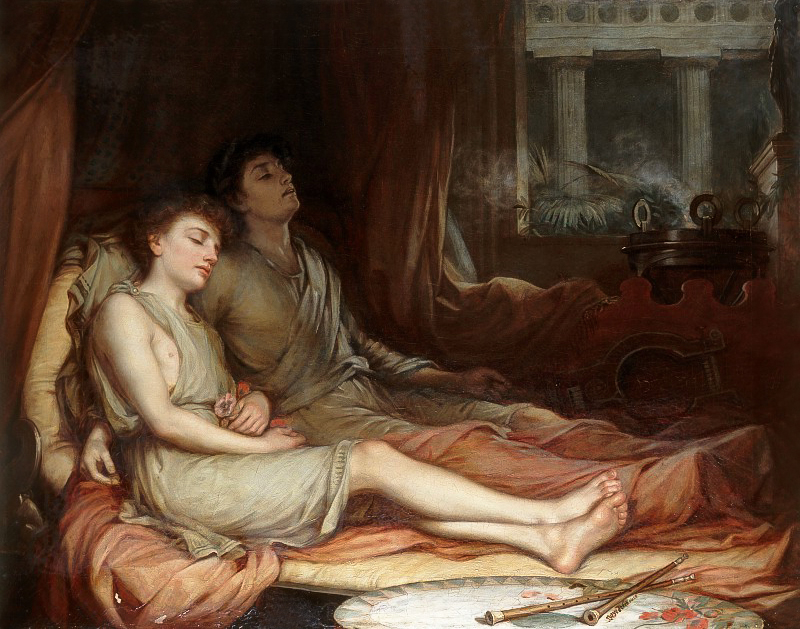
Sleep and his Half-Brother Death, 1874, oil on canvas, 70 x 91 cm.
Sleep and his Half-brother Death is a painting by John William Waterhouse completed in 1874. Waterhouse’s first Royal Academy exhibit (submitted from his father’s house at 1 Scarsdale Villas), it was painted after both his younger brothers died of tuberculosis.
The painting itself is a reference to the Greek gods Hypnos (sleep) and Thanatos (death) who, in the Greek mythology, were brothers. Despite their similar poses in the painting, the character in the foreground is bathed in light, while his brother is shrouded in darkness; the first therefore represents Sleep, the latter Death. The personification of Sleep clasps poppies, symbolic of narcosis and dreamlike-states.
J.A. Blaikie gave a brief critique of this painting in ‘The Magazine of Art’ (1886): ‘The two figures recline side by side on a low couch, beyond which are the columns of a colonnade open to the night and touched with moonlight. The interior is lit by a lamp, whose light streams on the foremost figure, Sleep, whose head hangs in heavy stupor on his breast, and his right hand grasps some poppies. By his side lies Death in dusky shadow, with head thrown back, and the lines of the figure expressive of easeful lassitude. At his feet is an antique lyre, while immediately in the foreground is a low round table… The two figures are both young, and the beauty of youth belongs to one as much as to the other… the strange likeness and unlikeness of the recumbent figures.’


 John William Waterhouse