
Study for The Awakening of Adonis

Study for The Awakening of Adonis
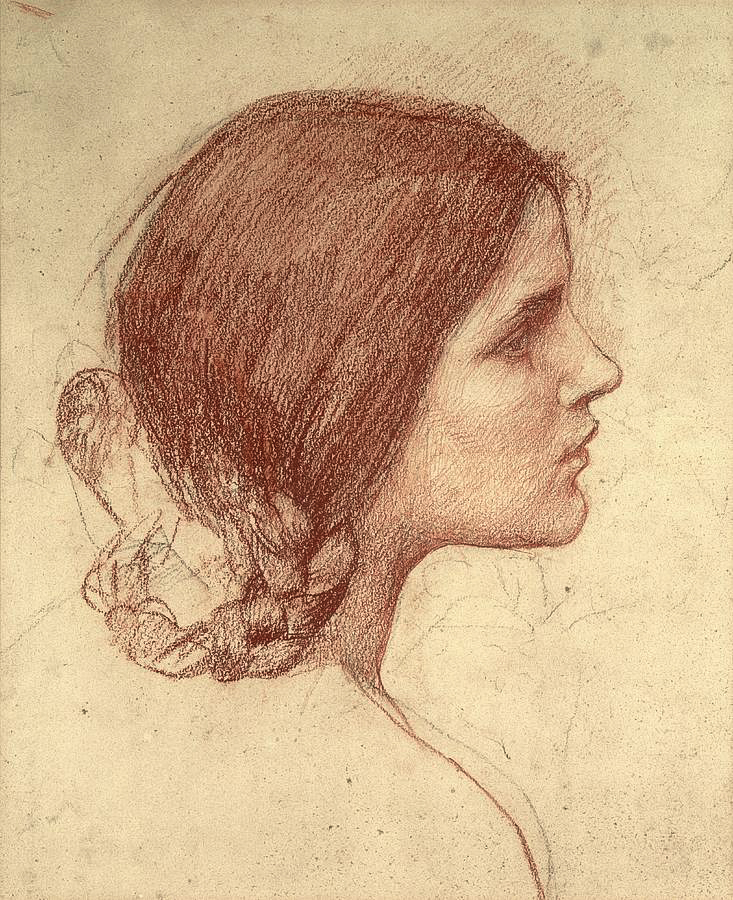
As Christopher Wood remarked in 1981 ‘One cannot help speculating about the identity of the mysterious and beautiful model who reappears so often in …Waterhouse’s pictures’ C. .Wood, The Pre-Raphaelites, London, 1981). In the early years of Waterhouse’s career it appears that his sisters, Jessie and Mary, and his wife, Esther, fulfilled the role of artist’s model; however once he became an established painter, three other women seem to have become his regular models.
The most consistent of these was Miss Muriel Foster, and it is possibly her features that we see in the present drawing. Her name is known from a single inscription on a pencil sketch for Lamia, 1905 (private collection); however her face is perhaps one of the best known in Pre-Raphaelite art. If we look at the characteristic tilt of the model’s long neck, her slightly pointed chin, fractionally upturned nose, delicately modelled lips and loosely plaited hair, we can see the face of the woman who appears in some of Waterhouse’s most famous paintings. She is recognisable in La Belle Dame Sans Merci, 1893 (Hessisches Landesmuseum, Darmstadt), Psyche opening the Door into Cupid’s Garden, circa 1900, (Harris Muesum and Art Gallery, Preston), and A Mermaid, 1892-1900 (Royal Academy of Arts, London) amongst others.
Baker and Baker, ‘Miss Muriel Foster: The John William Waterhouse Model’, The Journal of Pre-Raphaelite Studies, 8, Toronto, Fall 1999, suggest that Muriel Foster sat for all Waterhouse’s paintings between 1893 and 1906 and again for those at the end of his life. Waterhouse’s two other models appear to have sat for fewer pictures than Muriel Foster. The dark intense features of one whose identity is still unknown appears in Circe Offering the Cup to Odysseus, 1891 (Oldham Art Gallery) and Circe Invidiosa, 1892 (Art Gallery of South Australia, Adelaide) and the slightly less elfin features of Beatrice Ethel Hackman are most likely depicted in the previous lot 3.
Although there is no evidence of anything other than admiration between the artist and his model, Waterhouse’s dedication to Muriel Foster as a sitter was extraordinary. It is thought that she is the same Muriel Foster who appears in a birth register at Greenwich in 1878, who trained as a nurse and remained unmarried until her death at the age of ninety-one. Although the model’s appearance varies frequently in terms of hair-colour and attitude, through the years we see her maturing under the artist’s brush. Her soft teenage features in his early works such as La Belle Dame Sans Merci become the sharper, clearly defined features of a woman in The Enchanted Garden, 1916-17 (Lady Lever Art Gallery, Port Sunlight), one of the last pictures that Waterhouse ever painted.
The softness and warmth of the red chalk used in the present drawing compliments the sensitivity of Waterhouse’s modelling. The use of this medium, instead of a harder graphite pencil, lends the study the depth and richness characteristic of his finished oils. Although we cannot be certain that the present drawing is of Muriel Foster, the beautiful intimacy of this chalk study appears to demonstrate the effortless tracing of a familiar face.


In classical mythology the sorceress Medea was the daughter of King Aeetes of Cholchis to whose kingdom the hero Jason and his Argonauts travelled in search of the treasured Golden Fleece. Medea used her magical skills to make a potion for Jason, with whom she had fallen in love, to imbue him with invulnerability and superhuman power during his imperiled and terrifying quest for the fleece.
From the early 1890s Waterhouse concentrated increasingly upon subjects from mythology, painting a striking series of pictures that are among the most compelling and darkly beautiful of all Victorian paintings. Among the most important mythological pictures of this period were Ulysses and the Sirens of 1891 (National Gallery of Victoria, Melbourne), Hylas and the Nymphs of 1896 (Manchester City Art Gallery), Flora and the Zephyrs of 1898 (sold in these rooms, 6 November 1996, lot 307) and Echo and Narcissus of 1903 (Walker Art Gallery, Liverpool). The sorceress subject had first been painted by Waterhouse in 1886 in The Magic Circle (Tate Britain) and in 1891 he painted his first potion-themed picture depicting a beautiful witch holding aloft a magical liquid in Circe Offering the Cup to Ulysses (Oldham Art Gallery). The motif continued in 1892 when he painted Homer’s sorceress again, enchanting the sea with lurid green poison in Circe Invidiosa (Art Gallery of South Australia, Adelaide).
Medea was a favourite subject for nineteenth century painters. Notable depictions include those by Frederick Sandys of 1868 (Birmingham Museum and Art Gallery), Valentine Cameron Prinsep of 1888 (Art Gallery of South London) and Waterhouse’s friend Herbert Draper, who painted a dramatic image of Medea and Jason’s departure from Colchis in his 1904 work The Golden Fleece (Bradford City Art Gallery). In Europe the subject of female sorcery also had innumerable artistic supporters, finding its zenith with Symbolist artists like Gustave Moreau, Fernand Khnopff and Gustave Klimt who made Medea one of their queens of decadence, sexuality and exoticism. Thus, Waterhouse’s images of magic and mythology can be regarded in a wider European context.
In the present work Waterhouse has laboured first and foremost to convey the wistful charm and psychological intensity of his subject at the pivotal moment in a private drama as she pauses and ponders all that is about to transpire.

Peter Trippi identifies the present work as a likely Neapolitan subject dating from c.1877 and painted on one of a number of documented painting trips that Waterhouse made to Italy. Here Waterhouse encountered an oddly antiquated world that would appear largely untouched by the dramatic advances seen in industry and society in nineteenth century England: “the small, sparkling, An Italian Produce Shop…may be – the watercolour A Chestnut Vendor which Waterhouse exhibited at Dudley in 1879. Although the costumes locate this scene in the nineteenth century, it could almost be antique, so little had changed in Italy in contrast to London.” (Trippi, op cit, p.37). Such trips were to provide inspiration for the mythical world of the great Classical subjects he executed later in his career.

Born in Rome, Waterhouse felt a natural affinity with Italy, returning at various stages of his career. Largely undiscovered by tourists owing to its inaccessibility, Capri became a mecca for artists owing to its natural beauty. Leighton first visited in 1859, Sargent in 1878, and Waterhouse by 1888. All were struck by the extraordinary quality of the light, recorded by Leighton in a series of oil sketches.


Study for Jason and Medea.


 John William Waterhouse