Dolce far niente

painting
John William Waterhouse-Dolce far niente
Dolce far niente, 1879, oil on canvas, 49.6 x 36.2 cm.

Reclining and facing the light, a lone woman plucks feathers from a fan and watches them float in the air. She seems completely removed from everyday life, yet in this languid state there is a sense of beauty emphasised by the sunflowers, the decorative rug, cushions and curtain, and the warm tone of the painting. The Italian phrase dolce far niente means ‘the sweetness of doing nothing’—the pleasure of being idle and blissfully lazy. Painters of the Aesthetic movement, as Peter Trippi points out, favoured the theme of idleness because it ‘liberated them from illustrating narratives and pointing to morals, seeking only beauty through harmonious arrangements of form, line and colour’. (1) William Holman Hunt had exhibited his own Il dolce far niente in 1867 and, although he griped about the creation of works that existed only for the ‘mere gratification of the eye’, he enjoyed ‘the opportunity of exercising [himself] in work which had not any didactic purpose’. (2)

A contemporary of the Pre-Raphaelites, John William Waterhouse is known for embracing the Brotherhood’s subject matter and style, and he shared their interest in Italy as a key source of inspiration. In 1871, a critic for The Art Journaldescribed a new style of painting by artists who ‘cherish in common, reverence for the antique, affection for modern Italy; they affect southern climes, costumes, sunshine, also a certain dolce far niente style, with a general Sybarite state of mind which rests in Art and aestheticism as the be-all and end-all of existence’. (3) Although Waterhouse was not one of the artists the critic was discussing, it was in this spirit that he painted two distinct works bearing the same title. (4)

Dolce far niente 1879 presents a stylistic change for Waterhouse. Inspired by Dutch painter Sir Lawrence Alma-Tadema’s shift to lighter tones in the 1870s, he began to ‘open the shutters of his gloomy classical rooms’. (5) Despite the muted, antiquarian setting in this work—hinted at by the white mottled wall and the oil lamp that hangs before it—the painting appears fresh and modern.(6) Waterhouse experiments with the effects of sunlight on his figure; his use of short brushstrokes adds texture to the painting and is particularly effective in capturing the contrast between the three floating feathers and the  white wall. (7)

Honouring the Pre-Raphaelite’s dedication to ‘truth to nature’ and of layering symbolic meanings in their paintings, the sunflowers that appear at the lower right of the composition and in the background are a critical component of Dolce far niente. Sunflowers represent adoration and self-admiration, a meaning made familiar in the mid-to-late nineteenth century through the popular literature of the language of flowers, (8) and the theme echoes through the scene—the woman feels at ease with herself, content doing nothing, basking in the sunlight like a sunflower blooming in the summer. Emblematic of the Aesthetic and Arts and Crafts movements, sunflowers became a fashionable and much-used design element, so much so that it was acidly commented upon in a women’s journal: ‘a blue pot and a fat sunflower … are all that is needed to be fashionably aesthetic.’ (9)

Bianca Winataputri

Source

1. Peter Trippi, JW Waterhouse, Phaidon Press, London and New York, 2002, p 43.
2. Judith Bronkhurst, William Holman Hunt: A catalogue raisonné, published for the Paul Mellon Centre for Studies in British Art by Yale University Press, New Haven and London, 2006, vol 1, pp 187–8.
3. The Royal Academy, The Art Journal, 1 July 1871, p 176.
4. Dolce far niente 1880 is in Kirkaldy Galleries, Scotland.
5. Trippi, p 43.
6. Elizabeth Prettejohn, Peter Trippi, Robert Upstone and Patty Wagemen, JW Waterhouse: The modern Pre-Raphaelite, Royal Academy of Arts, London, 2008, p 80.
7. As above.
8. Trippi, p 43; the language of flowers attributed meanings and symbolic associations to plants, flowers and floral arrangements that had been practiced in traditional cultures throughout Europe, Asia and the Middle East. The dictionary of floriography, Le langage des Fleurs, by Louise Cortambert (writing under the pen name ‘Madame Charlotte de la Tour’) was first published in 1819.
9. Quoted in Debra N Mancoff, Flora symbolica: Flowers in Pre-Raphaelite art, Prestel, Munich, Berlin, London, New York, 2003, p 72—the significance of sunflowers is also discussed pp 9, passim 64–75; correspondence with Carol Jacobi.


Circe Invidiosa

painting
John William Waterhouse - Circe Invidiosa
Circe Invidiosa, 1892, oil on canvas, 179 x 85 cm.

In Ovid’s Metamorphosis the merman Glaucus desires the nymph Scylla and begs Circe to charm her into returning his affections. But as Circe is invidiosa (Latin for jealous) and wants Glaucus for herself, she poisons the waters in which Scylla bathes, causing her to be transformed into a sailor-devouring monster. In John William Waterhouse’s Circe invidiosa 1892, the sorceress is shown bolt upright, focused intently on holding the large vessel and controlling the stream of liquid, her weight and the poison serving to contain the nymph-monster below. Angus Trumble observes that the figure:

“derives great expressive power from the almost liturgical formality with which the sorceress administers her poison. The peacock robe, the bowed head, erect posture and air of concentration, the ceremonial way she holds up the bowl with both hands and slowly drains the green concoction … suggest the solemnity of a perverted ritual.” (1)

Circe’s emphatic verticality is countered by the diagonals and curves of the broadly rendered landscape. The tree trunks are crowned with a fringe of foliage, while the rock forms and swirling waters are so stylised as to lack any substance. Indeed, the calligraphic quality, dimensions and proportions of Waterhouse’s canvas are inspired by Asian screens and show the impact of Japanese art more generally. The painting also demonstrates the artist’s awareness of new developments in archaeology, anthropology, comparative mythology, the study of ancient and modern religions, occultism and the revival of paganism. (2)

Waterhouse had painted another Circe the previous year, Circe offering the cup to Ulysses (3), showing the sorceress seated on a throne holding a cup and wand aloft, with Ulysses and his ship reflected in the mirror behind her and a seaman-turned-boar at her feet. Circe invidiosa is, by contrast, remarkably economical, both in palette and attributes. Glaucus, previously a mortal man, discovered a herb that brought back to life the fish he had caught, and decided to try it himself. The substance gave him fins and a tail, as well as immortality, and Waterhouse plays with these notions of transformation. Trumble points out that the artist retouched the painting before sending it to the Art Gallery of South Australia, changing several aspects of the composition, including softening the pattern of ripples on the water’s surface, and making the serpentine tail less visible and therefore more sinister. (4)

A critic at the time described Circe invidiosa as a ‘Burne-Jones and French mixture, strange, interesting and beautiful in colour’. (5) Another went further, declaring Circe invidiosa an ‘excellent example of professional French painting’, and pointing out how the drawing is planned ‘geometrically [and] the modelling is built up mechanically’ but, ultimately, concluding the work ‘theatrical and pedantic’. (6) The comparison to contemporary French art was largely due to Waterhouse’s complex layering, thick brushwork, use of impasto and the ways he builds up the flesh, hair and drapery. Elizabeth Prettejohn proposes a more personal reason for the palette, suggesting that Waterhouse took inspiration from his time in Italy: the caves of Capri and the Amalfi Coast famous for their blue-green water and light effects. (7)

Lucina Ward

Source

1. Angus Trumble, Love and death: Art in the age of Queen Victoria, Art Gallery of South Australia, Adelaide, 2001, p 102.
2. Elizabeth Prettejohn, ‘Waterhouse’s imagination’, in Elizabeth Prettejohn, Peter Trippi, Robert Upston and Patty Wageman, JW Waterhouse: The modern Pre-Raphaelite, Royal Academy of Arts, London, 2008, pp 23–9, at p 23.
3. Collection Oldham Art Gallery, Manchester.
4. Trumble, p 102.
5. Saturday Review, 14 May 1892, p 569; quoted by Peter Trippi, JW Waterhouse, Phaidon Press, London and New York, 2002 p 116.
6. Fortnightly Review, no 57, 1892, p 833; quoted by Trippi, p 115.
7. Prettejohn et al, p 120.

Gossip / Good Neighbours

painting
Gossip / Good Neighbours
Gossip / Good Neighbours, 1885, oil on canvas, 72.1 x 92.7 cm.

The second half of the 1880s witnessed J. W. Waterhouse’s most intense interest in landscape and outdoor genre subjects, and his fascination with effects of natural light. At this time he was in close contact with a group of landscape specialists, including William Logsdail, who was a neighbour at the Primrose Hill Studios, and Frank Bramley, who Waterhouse appears to have visited in Cornwall at least once. It was perhaps through this circle that Waterhouse came to appreciate the work of Jules Bastien Lepage. The pure landscapes and figure studies that Waterhouse made in the course of painting expeditions in the English countryside, and particularly when in Italy, are adapted from the principles of the French artist, containing an Impressionistic feeling for the quality of light, but also being carefully arranged to give a pleasing and decorative pictorial effect. Close parallels can be drawn between this work and Lepage’s most famous painting Jeanne d’Arc Écoutant les Voix (Metropolitan Museum of Art, New York), particularly in the depiction of the trees and the crumbling stone walls. The observation of the wall, the foliage and the moss-covered yard is meticulous and highly accomplished, whilst the gestures of the figures are convincing and sensitively studied. The attention to realistic harmony of colour and naturalistic detail is paramount in these early pictures, which were to an extent eclipsed by the idealism of the nymphs and sorceresses that increasingly dominated his work from the 1890s onwards. The early works of Waterhouse bear comparison with the best work of the Newlyn painters, particularly Langley and Forbes, with whom Waterhouse was also associated at this time. By viewing Waterhouse as an artist connected to the ideals of the Newlyn School, rather than as a follower of Burne-Jones and Leighton, it is clear to see that the aims of his early work were innovative, modern and progressive and that he was striving towards a realism which was overtaken in later years by a quest for idealised beauty.

Gossips was painted only a year after Waterhouse’s great early masterpiece Saint Eulalia of 1884 (Tate Britain). It predates Mariamne (private collection) by two years, The Lady of Shallot (Tate Britain) by three years and the first version of Ophelia (collection of Lord Lloyd Webber) by four years. The 1880s were, without doubt, Waterhouse’s most innovative years when inspired ideas germinated and memorable paintings were undertaken.

From Christie’s catalogue

Source

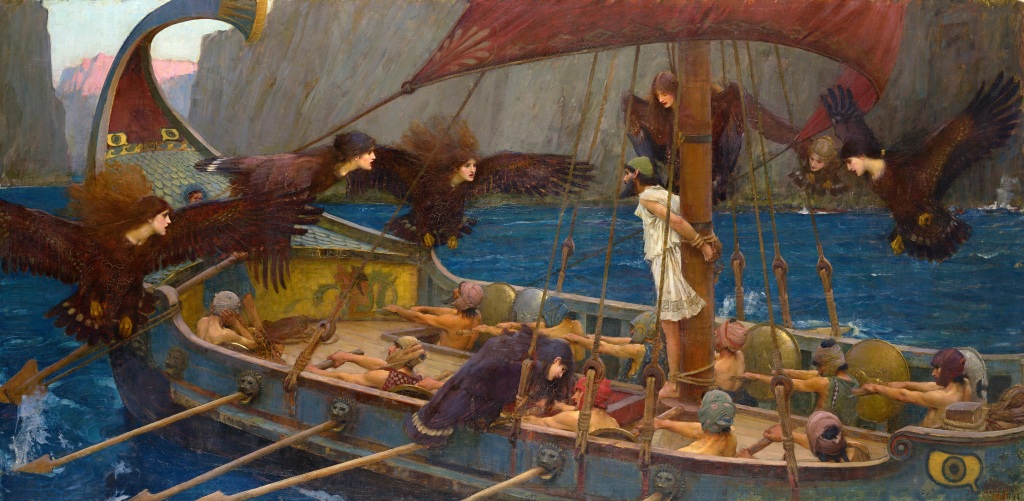
Ulysses and the Sirens

painting
John William Waterhouse - Ulysses and the Sirens
Ulysses and the Sirens, 1891, oil on canvas, 100.6 x 202 cm. National Gallery of Victoria

When Ulysses and the Sirens was first exhibited, at London’s Royal Academy in 1891, the painting was praised by most art critics of the day. M. H. Spielmann, writing for the Magazine of Art, declared it:
a very startling triumph … a very carnival of colour, mosaicked and balanced with a skill more consummate than even the talented artist was credited with … The quality of the painting is … a considerable advance upon all his antecedent work.

At the time of Sir Hubert von Herkomer’s purchase of this picture for the National Gallery of Victoria, in June 1891, the Ulysses was only the second work by John William Waterhouse – a painter renowned for his depictions of Greek and Roman subjects – to be acquired for a public gallery. This dramatic painting illustrates an episode from the journeys of the Greek hero Odysseus, as told in the ancient Greek poet Homer’s epic poem The Odyssey. The 1891 Royal Academy exhibition catalogue summarized the Homeric narrative:

The Sirens, who with their melodious voices lured all navigators to destruction … were, according to classical tradition, creatures having the body of a bird with the head of a beautiful woman … They were informed by the oracle that as soon as any passed by without heeding their songs they should perish. Ulysses (the Roman name for Odysseus), warned by Circe, stopped (with wax) the ears of his companions and ordered himself to be bound to the mast, and so successfully passed the fatal coast.

Homer did not, however, provide a physical description of the sirens’ appearance. To achieve authenticity in his depiction, Waterhouse turned to a painted representation of the Homeric story on an ancient Greek vase at the British Museum in London. The vase showed the sirens as winged and clawed birds with human faces, a concept that was taken up by Waterhouse and that came as a surprise to Victorian audiences, who were more used to seeing these mythic creatures portrayed as comely mermaid-like nymphs. (Text by Dr Ted Gott from 19th century painting and sculpture in the international collections of the National Gallery of Victoria, National Gallery of Victoria, Melbourne)

Source

The Enchanted Garden

painting
John William Waterhouse - The Enchanted Garden
The Enchanted Garden, 1916-1917, oil on canvas, 115.5 x 160 cm.

The Enchanted Garden illustrates a scene from Boccaccio’s ‘Decameron’. This tells the tale of a group of young people who, fleeing from the plague in 14th century Florence, spend ten days isolated in the country. Every day a different member of the group was chosen to be king or queen, and gained authority over the group for that day alongside the responsibility for relating a tale to entertain them.
‘The Enchanted Garden’ relates an episode from one of these stories. Another painting by Waterhouse, also exhibited in the Lady Lever Art Gallery entitled ‘A Tale from the Decameron’, (1916) illustrates the group of young men and women telling their tales.

The story behind the painting recounts an episode from Ansaldo’s pursuit of Dianora. Although already married, in a moment of recklessness Dianora says she will yield to Ansaldo if he achieves the impossible and produces, in January, a garden with the flowers, foliage and fruits of May. As the painting demonstrates, with the help of a magician Ansaldo succeeds in his task, and creates a spring garden despite the snow that was falling outside in the ‘real world’. Dianora is now faced with a difficult situation, but decides to confess all to her husband, Gilberto. Gilberto suggests she must comply with Ansaldo’s desires, however, moved by Dianora’s honesty to her husband, Ansaldo releases her from her reckless contract.

The artist’s death in February 1917 left the painting uncompleted and it was a tribute to Waterhouse that it was displayed in the Academy later that year, despite its unfinished state. In some ways the subject of the painting mirrors the artists own life. Just as Ansaldo’s garden created an idyll of spring flowers in the depth of winter, Waterhouse created a haven of warmth in the winter of his life by spending his time and energy immersed in this painting.

The painting is rooted firmly in the realms of the imagination. Waterhouse writer Anthony Hobson suggests that it is his love of legend and mystery, unerring sense of composition and the instinct for the moment in the story at which everything stands still for our contemplation that defines Waterhouse’s work.

Liverpool was one of Waterhouse’s main exhibition centres and his work was regularly exhibited in the Walker from 1879 until the year before his death. Lord Lever was one of his important patrons, particularly in the artist’s later years and purchased the painting for £500 from Waterhouse’s widow.

Study drawing for The Enchanted Garden (Victoria and Albert Museum)

Source

Hylas and the Nymphs

painting
John William Waterhouse - Hylas and the Nymphs
Hylas and the Nymphs, 1896, oil on canvas, 98.2 x 163.3 cm.

Hylas and the Nymphs is an 1896 oil painting by John William Waterhouse. The painting depicts a moment from the Greek and Roman legend of the tragic youth Hylas, based on accounts by Ovid and other ancient writers, in which the enraptured Hylas is abducted by Naiads (female water nymphs) while seeking drinking water. The painting has been interpreted as a metaphor for dangerous female sexuality, and warning against nymphomania.
Hylas was the son of King Theiodamas of the Dryopians. After Herculeskilled Hylas’s father, Hylas became a companion of Hercules and later his lover. They both became Argonauts, accompanying Jason in his quest on his ship Argo in seeking the Golden Fleece. During the journey, Hylas was sent to find fresh water. He found a pond occupied by Naiads, and they lured Hylas into the water and he disappeared.
The painting measures 98.2 by 163.3 centimeters (38.7 in x 64.3 in). It depicts Hylas, a male youth in classical garb, wearing a blue tunic with a red sash, and bearing a wide-necked water jar. He is bending down beside a pond in a glade of lush green foliage, reaching out towards seven young women, the water nymphs, who are emerging from the pond among the leaves and flowers of Nymphaeaceae (water lilies), including an early depiction of the yellow waterlily, Nuphar lutea). The nymphs are naked, their alabaster skin luminous in the dark but clear water, with yellow and white flowers in their auburn hair. They have very similar physical features, perhaps based on just two models.

Hylas is being enticed to enter the water, from which he will not return. One of the nymph holds his wrist and elbow, a second plucks at his tunic, and a third holds out some pearls in the palm of her hand. The face of Hylas in profile is shadowed and barely visible, but the faces of the nymphs are clearly visible as they gaze upon him. The scene is depicted from a slightly elevated position, looking down at the water like Hylas, so no sky is visible. Hylas’s position forces the viewer’s focus onto the nymphs in the water and the lack of reference to his relationship with Hercules emphasizes that the narrative of the painting is not about Hylas narrative, but about the sinister nature of the nymphs.

Some of Waterhouse’s preparatory sketches are in the Ashmolean Museum in Oxford.

Source